Cambridge IGCSE Mathematics — 0580 Extended
Topic 6.4: Trigonometry — Trigonometric Functions
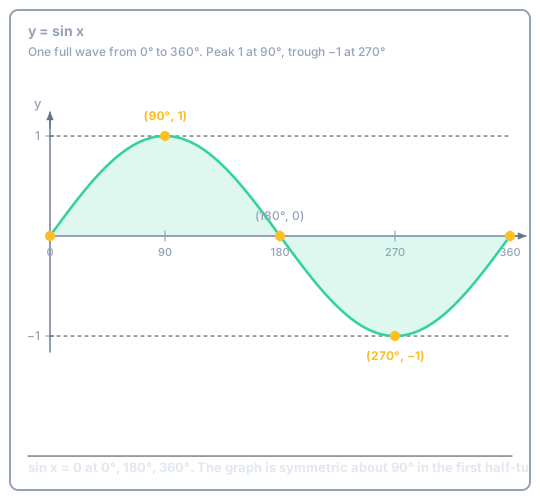
\(y = \sin x\) for \(0^\circ \le x \le 360^\circ\)
One full wave. It starts at \(0\), peaks at \(1\) when \(x = 90^\circ\), returns to \(0\) at \(180^\circ\), reaches \(-1\) at \(270^\circ\), and finishes at \(0\) when \(x = 360^\circ\).
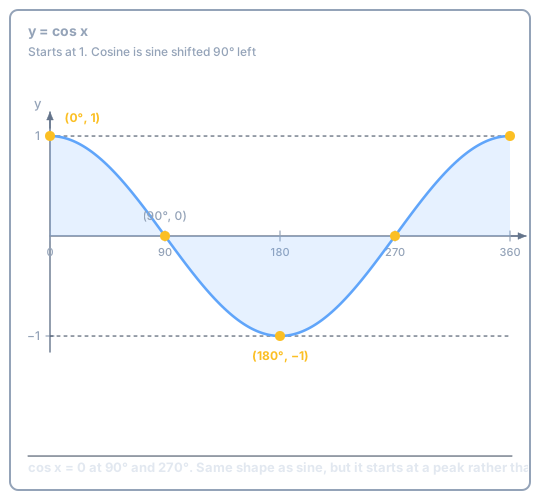
\(y = \cos x\)
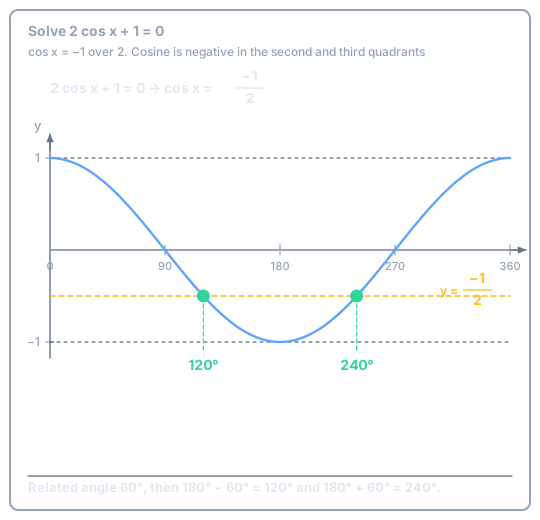
The same wave as sine, shifted \(90^\circ\) left, so it starts at a peak. \(\cos 0^\circ = 1\), \(\cos 90^\circ = 0\), \(\cos 180^\circ = -1\), \(\cos 270^\circ = 0\), \(\cos 360^\circ = 1\).
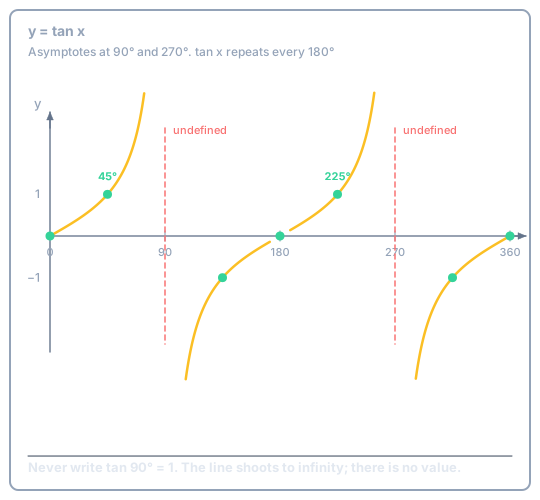
\(y = \tan x\)
Tangent repeats every \(180^\circ\). It has vertical asymptotes at \(90^\circ\) and \(270^\circ\) — those values are undefined. \(\tan 0^\circ = \tan 180^\circ = \tan 360^\circ = 0\), and \(\tan 45^\circ = \tan 225^\circ = 1\).
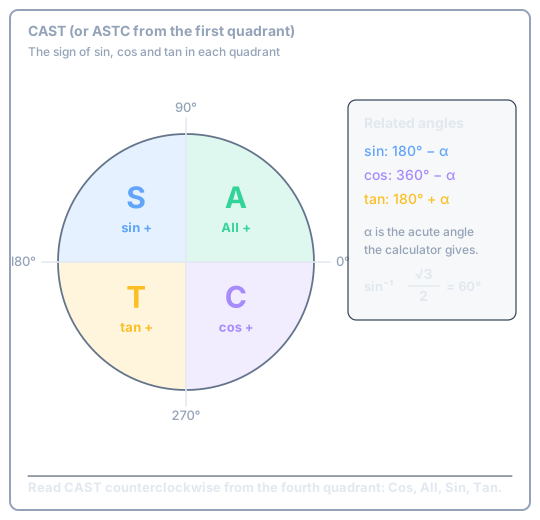
CAST and related angles
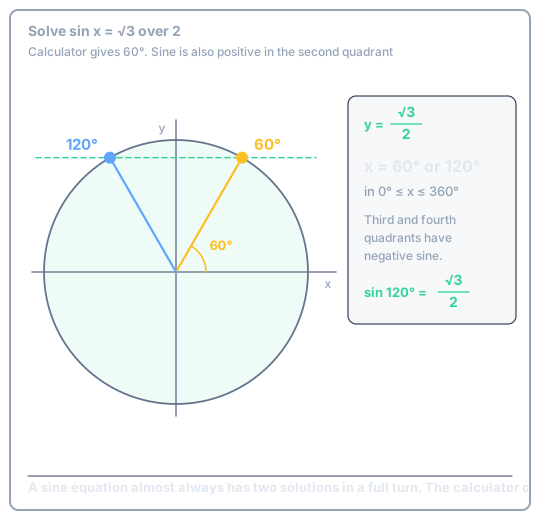
The calculator inverse gives one acute angle \(\alpha\). A full turn almost always has a second solution. CAST (read counterclockwise from the fourth quadrant: Cos, All, Sin, Tan) tells you which quadrants are allowed.
- Sine positive: \(\alpha\) and \(180^\circ - \alpha\)
- Cosine positive: \(\alpha\) and \(360^\circ - \alpha\)
- Tangent positive: \(\alpha\) and \(180^\circ + \alpha\)
Solving equations in \(0^\circ \le x \le 360^\circ\)
Method
- Rearrange so that \(\sin x\), \(\cos x\) or \(\tan x\) is the subject.
- Find the acute related angle \(\alpha\) from the calculator (or from exact values).
- Use CAST to list every solution in the interval. Check the endpoints \(0^\circ\) and \(360^\circ\) if the value is \(0\).
Solve \(\sin x = \dfrac{\sqrt{3}}{2}\) for \(0^\circ \le x \le 360^\circ\).
Solve \(2\cos x + 1 = 0\) for \(0^\circ \le x \le 360^\circ\).
Paper 2 (non-calculator)
When the right-hand side is an exact value from Topic 6.3, \(\alpha\) is one of \(0^\circ\), \(30^\circ\), \(45^\circ\), \(60^\circ\), \(90^\circ\). You should not need a calculator for \(\sin x = \frac{\sqrt{3}}{2}\) or \(2\cos x + 1 = 0\).
Try this
Solve \(\tan x = 1\) for \(0^\circ \le x \le 360^\circ\).
Show answer
-
Related angle: \(\tan 45^\circ = 1\)
\[ \alpha = 45^\circ \] -
Tan is positive in the first and third quadrants
\[ x = 45^\circ \quad\text{or}\quad x = 180^\circ + 45^\circ = 225^\circ \]
Exam Traps
- The calculator reports only one solution. In \(0^\circ\) to \(360^\circ\) a sine or cosine equation almost always has two; missing the second loses a mark.
- Degree mode still applies. \(\sin^{-1}\left(\frac{\sqrt{3}}{2}\right)\) should be \(60\), not a small number of radians.
0/10