Cambridge IGCSE Mathematics — 0580 Extended
Topic 6.5: Trigonometry — Non-right-angled Triangles
Labelling, and which formula
These three results are on the formula sheet. What the sheet cannot tell you is when to use each one. Lower-case \(a\) is the side opposite capital \(A\).
\[ \frac{a}{\sin A} = \frac{b}{\sin B} = \frac{c}{\sin C} \]
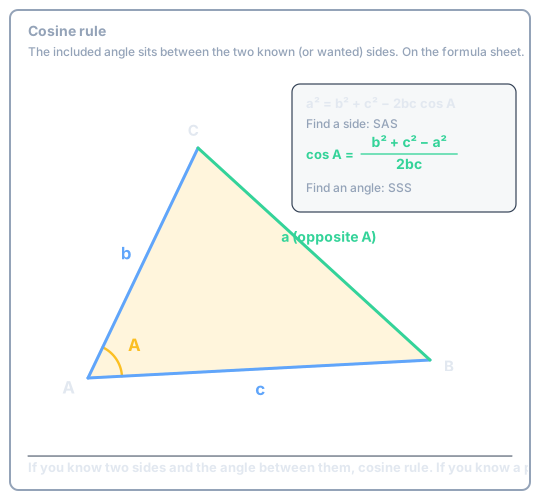
\[ a^2 = b^2 + c^2 - 2bc\cos A \qquad \text{Area} = \tfrac{1}{2}ab\sin C \]
- Sine rule — you have a matching pair (a side and its opposite angle) and want another pair. Typical givens: ASA or SSA.
- Cosine rule for a side — two sides and the included angle (SAS).
- Cosine rule for an angle — all three sides (SSS).
- Area — two sides and the included angle.
If the triangle is right-angled, go back to Topic 6.2: SOHCAHTOA and Pythagoras are faster than these formulae.
Sine rule
A side over the sine of its opposite angle. Use it as soon as you have one complete pair, and you need another side or another angle.
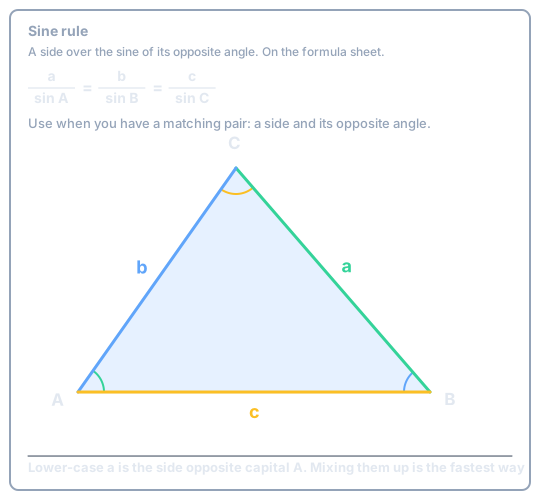
In triangle \(ABC\), \(A = 40^\circ\), \(B = 75^\circ\) and \(a = 8\,\text{cm}\). Find \(b\).
-
Matching pair \(a,A\) is known; want \(b\) opposite \(B\)
\[ \frac{b}{\sin 75^\circ} = \frac{8}{\sin 40^\circ} \] -
\(1\) d.p.
\[ b = 8 \times \frac{\sin 75^\circ}{\sin 40^\circ} = 12.0\,\text{cm} \]
The ambiguous case (SSA)
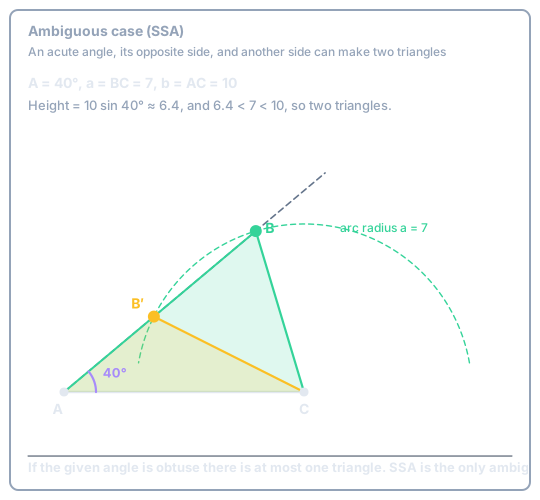
Given an acute angle, the side opposite it, and one other side, the swinging side can meet the opposite ray in two places. That is the only ambiguous configuration.
Let \(A\) be the given acute angle, \(a\) the opposite side and \(b\) the other given side. The height from the unknown vertex to side \(b\) is \(h = b\sin A\).
- If \(a < h\), no triangle.
- If \(a = h\), one right-angled triangle.
- If \(h < a < b\), two triangles.
- If \(a \ge b\), one triangle.
If the given angle is obtuse there is at most one triangle.
Cosine rule
The included angle sits between the two sides you know (or the two sides you will use). Rearrange to find an angle when all three sides are known:
\[ \cos A = \frac{b^2 + c^2 - a^2}{2bc} \]
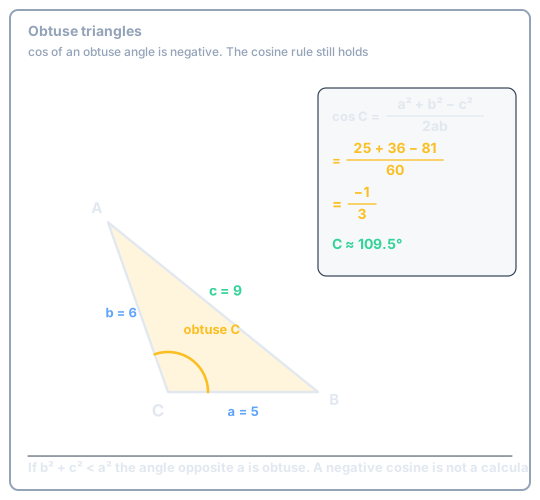
If \(b^2 + c^2 < a^2\), then \(\cos A\) is negative and \(A\) is obtuse. A negative cosine is not a calculator error.
Obtuse angles and the sine rule
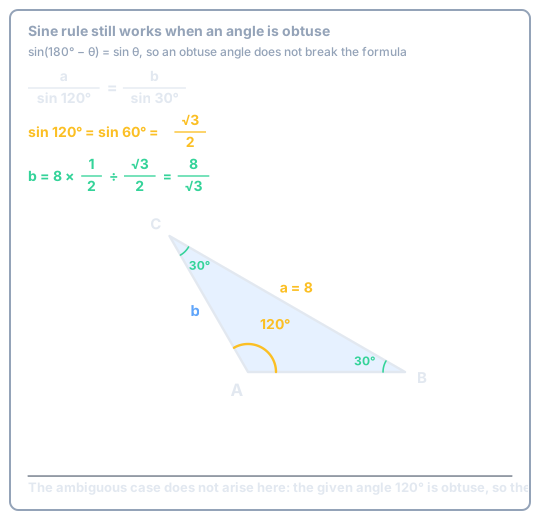
The sine rule still holds when an angle is obtuse, because \(\sin(180^\circ - \theta) = \sin\theta\). The ambiguous case does not arise when the given angle is obtuse.
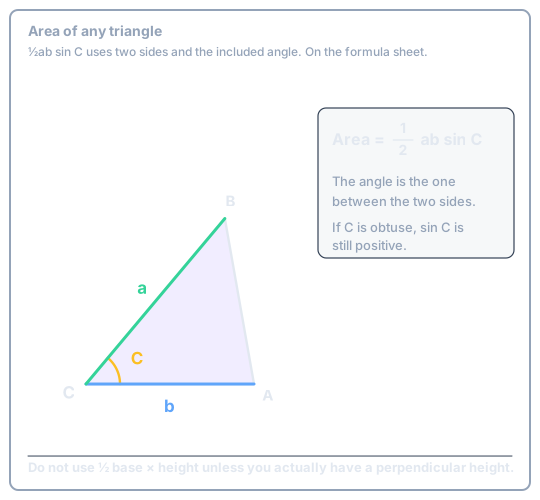
Area \(=\tfrac{1}{2}ab\sin C\)
Two sides and the included angle. \(\sin C\) is positive whether \(C\) is acute or obtuse, so the formula does not change.
Two sides of a triangle are \(7\,\text{cm}\) and \(9\,\text{cm}\) and the included angle is \(50^\circ\). Find the area.
-
Included angle, so the area formula
\[ \text{Area} = \tfrac{1}{2} \times 7 \times 9 \times \sin 50^\circ \] -
\(1\) d.p.
\[ = 24.1\,\text{cm}^2 \]
Try this
In triangle \(ABC\), \(b = 8\,\text{cm}\), \(c = 11\,\text{cm}\) and \(A = 70^\circ\). Find \(a\), to \(1\) d.p.
Show answer
-
Two sides and the included angle \(\to\) cosine rule, not sine rule
\[ a^2 = 8^2 + 11^2 - 2\times 8\times 11\cos 70^\circ \] -
Evaluate
\[ a^2 = 64 + 121 - 176\cos 70^\circ = 124.82\ldots \] -
\(1\) d.p.
\[ a = 11.2\,\text{cm} \]
Exam Traps
- SSA with an acute given angle can produce two triangles. If the question does not specify “the acute case” or a diagram, check whether a second triangle exists.
- If you already have a matching pair, the sine rule is enough. Reaching for the cosine rule wastes time and invites a substitution slip.
0/10