Cambridge IGCSE Mathematics — 0580 Extended
Topic 6.6: Trigonometry — Pythagoras & Trigonometry in 3D
Every 3D problem in this topic breaks down the same way: find a right-angled triangle that lies completely flat in one plane, solve it with Pythagoras or SOHCAHTOA, then — if needed — use that answer inside a second flat triangle. The solid is 3D; the maths never is.
Spot the right triangle that lies in one flat plane
A cuboid looks 3D, but every one of its six faces is an ordinary flat rectangle. Any length that runs between two corners of the same face is therefore a plain 2D Pythagoras problem — the 3D shape around it is irrelevant.
A cuboid has base edges \(AB = 2\,\text{cm}\) and \(BC = 3\,\text{cm}\). Find the length of the base diagonal \(AC\).
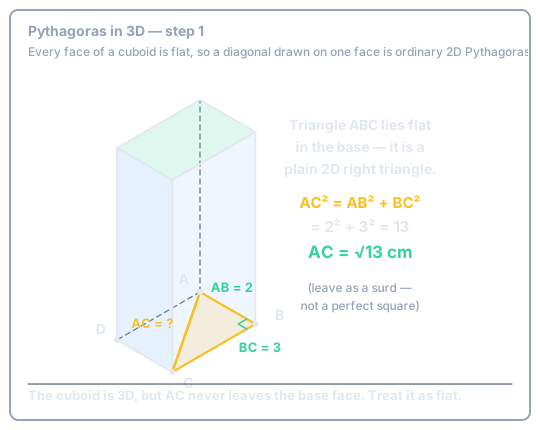
Leave the answer as a surd when it is not a perfect square — \(\sqrt{13}\) is exact, and a rounded decimal is not needed unless the question is a final numerical answer.
Method
- Find two points that lie on the same flat face of the solid.
- Redraw (mentally or on paper) just that face as a flat 2D shape.
- Apply ordinary Pythagoras or SOHCAHTOA — no 3D formula is needed.
The space diagonal: chain two flat triangles
A diagonal that runs from one corner of a cuboid to the opposite corner (through the middle of the solid) does not lie in any single face. Find it by using a face diagonal as one side of a second right-angled triangle.
The cuboid above also has height \(CG = 6\,\text{cm}\), where \(G\) is directly above \(C\). Find the space diagonal \(AG\).
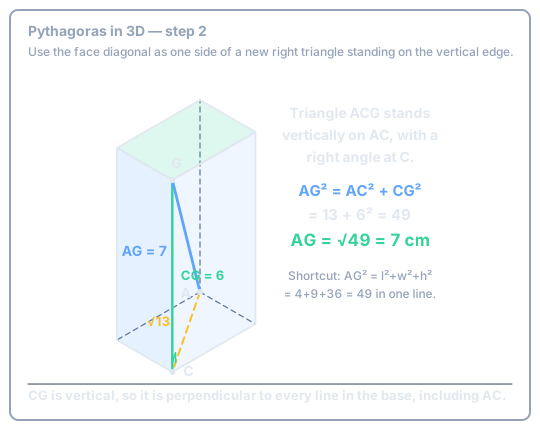
In general, for a cuboid with edges \(l\), \(w\), \(h\), the two steps combine into one formula:
\[ \text{space diagonal} = \sqrt{l^2 + w^2 + h^2} \]
Paper 2 (non-calculator)
Square each edge before adding: \(2^2 + 3^2 + 6^2 = 4 + 9 + 36 = 49\), then \(\sqrt{49} = 7\) exactly. You do not need to find \(\sqrt{13}\) as a separate decimal on the way — keep it as \(13\) inside the second squaring.
The angle between a line and a plane
This is the key definition for the rest of the topic. When a line meets a flat plane at a slant, the angle between them is not measured to just any edge of the plane — it is measured to the line's own shadow on the plane.
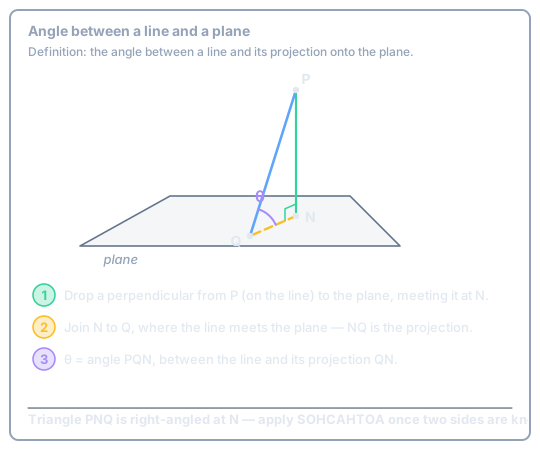
Triangle \(PNQ\) is always right-angled at \(N\), because \(PN\) is perpendicular to the whole plane and therefore perpendicular to \(NQ\) as well. Once you know two of its sides, \(\theta\) follows from SOHCAHTOA.
Exam Traps
- The angle between a line and a plane is not the angle between the line and one edge of the plane. Always construct the projection first — using the wrong edge gives a completely different (and larger) angle.
- Set the calculator to degrees before using \(\tan^{-1}\), \(\sin^{-1}\) or \(\cos^{-1}\). A calculator left in radians mode gives an answer with the right digits but the wrong units.
Worked example: angle between a diagonal and the base
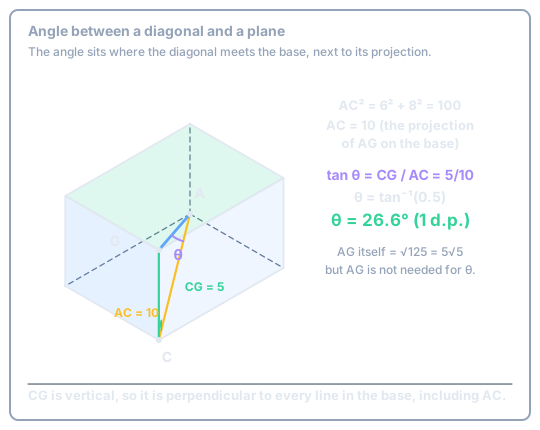
Apply the definition to a cuboid. The space diagonal's projection onto the base is simply the base's own diagonal, because the top face sits directly above the bottom face.
A cuboid has base \(6\,\text{cm}\) by \(8\,\text{cm}\) and height \(5\,\text{cm}\). Find the angle between the space diagonal \(AG\) and the base, correct to \(1\) decimal place.
Method
- Identify which base diagonal is directly beneath the space diagonal you care about — it must join the foot of the vertical edge to the point where the diagonal starts.
- Find that base diagonal's length with Pythagoras.
- The angle sits in the vertical right-angled triangle formed by the height, the base diagonal, and the space diagonal. Use SOHCAHTOA — usually \(\tan\theta = \dfrac{\text{height}}{\text{base diagonal}}\).
Try this
A cuboid has base \(3\,\text{cm}\) by \(4\,\text{cm}\) and height \(6\,\text{cm}\). Find the angle between the space diagonal and the base, correct to \(1\) decimal place.
Show answer
-
Find the base diagonal (the projection)
\[ \text{base diagonal} = \sqrt{3^2+4^2} = \sqrt{25} = 5\,\text{cm} \] -
Use \(\tan\theta = \dfrac{\text{height}}{\text{base diagonal}}\)
\[ \tan\theta = \frac{6}{5} = 1.2 \implies \theta = \tan^{-1}(1.2) = 50.2^\circ \]
Exam Traps
- Using the wrong face diagonal is the most common error here. A cuboid base has two diagonals; only the one running under your specific space diagonal is the correct projection. Sketch which base corner the vertical edge sits above before choosing a diagonal.
Pyramids: the slant-edge triangle
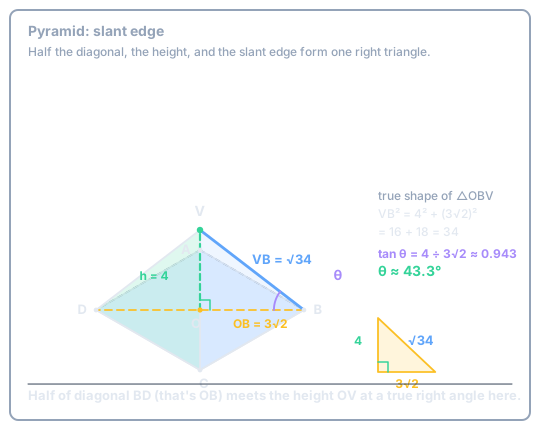
In a right pyramid, the apex sits directly above the centre of the base. The height, half of a base diagonal, and a slant edge always form one right-angled triangle — because the height is perpendicular to the whole base plane.
A square-based pyramid has base edge \(6\,\text{cm}\) and perpendicular height \(4\,\text{cm}\). Find the length of a slant edge, and the angle it makes with the base.
Method
- Find the full base diagonal, then halve it to get the distance from the centre to a base vertex.
- Use Pythagoras with the perpendicular height to find the slant edge.
- For the angle with the base, use SOHCAHTOA in the same right-angled triangle: \(\tan\theta = \dfrac{\text{height}}{\text{half-diagonal}}\).
The slant height of a triangular face (used for surface area, Topic 5.4) is a different length again — it runs from the apex to the midpoint of a base edge, not to a corner. Always check which of the two the question means.
Angle between two lines that meet in space
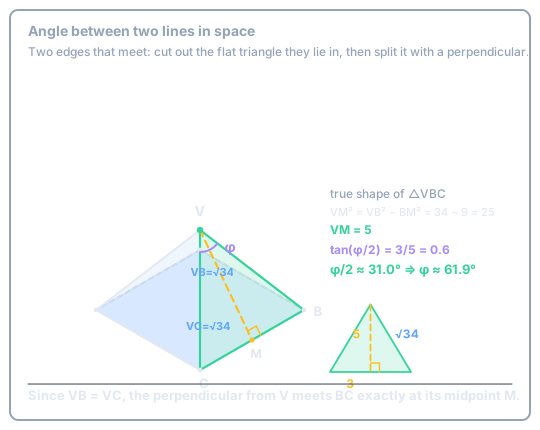
When two edges of a solid meet at a point, the angle between them lies inside whichever flat triangle contains both edges. Cut that triangle out, then look for a way to split it into two right-angled triangles.
Using the pyramid above, find the angle between the two slant edges \(VB\) and \(VC\), which meet at the apex \(V\).
Method
- Identify the flat triangle that contains both lines (often a face of the solid).
- If the triangle is isosceles, drop a perpendicular from the apex to the base — it lands exactly on the midpoint.
- Solve the right-angled half-triangle for half the angle, then double it.
Exam Traps
- Doubling too early loses marks. Find the half-angle from the right-angled triangle first, and only double it once \(\tan^{-1}\) has been evaluated — \(2\tan^{-1}(0.6) \neq \tan^{-1}(1.2)\).
0/10