Cambridge IGCSE Mathematics — 0580 Extended
Topic 7.1: Transformations — Reflection
A reflection flips a shape in a mirror line. The object and image are congruent: same size, same shape, opposite orientation. Each point and its image are the same distance from the mirror, and the line joining them is perpendicular to the mirror.
Horizontal mirrors
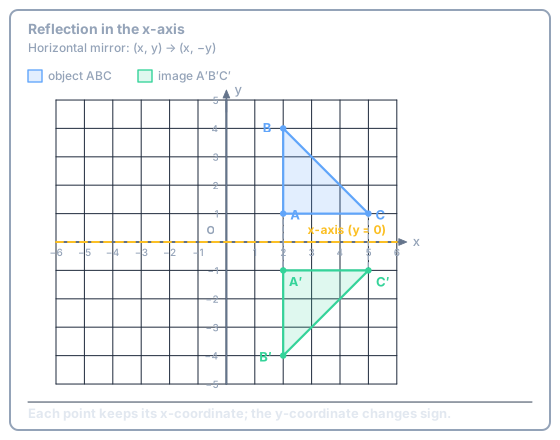
The \(x\)-axis is the line \(y = 0\). Reflection in the \(x\)-axis sends \((x, y)\) to \((x, -y)\): the \(x\)-coordinate stays, the \(y\)-coordinate changes sign.
Method
- Mark the mirror. For the \(x\)-axis that is the horizontal axis; for \(y = k\) it is the horizontal line through \(k\) on the \(y\)-axis.
- From each vertex, count the squares to the mirror, then the same number of squares the other side, along a line perpendicular to the mirror.
- Join the image vertices in the same order. Label them \(A'\), \(B'\), \(C'\).
Reflect triangle \(ABC\) with \(A(2, 1)\), \(B(2, 4)\), \(C(5, 1)\) in the \(x\)-axis.
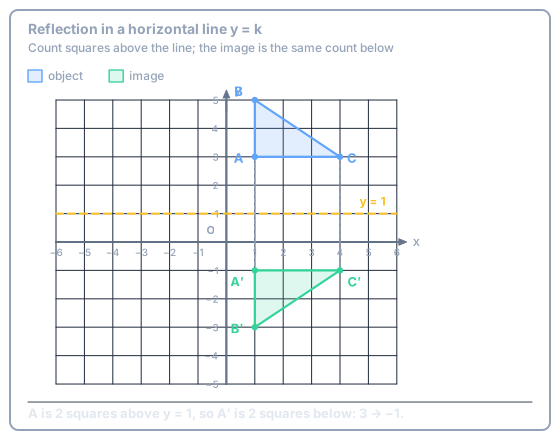
For a horizontal line that is not the \(x\)-axis, the same counting works. Reflection in \(y = k\) sends \((x, y)\) to \((x, 2k - y)\).
Reflect \(A(1, 3)\), \(B(1, 5)\), \(C(4, 3)\) in the line \(y = 1\).
Vertical mirrors
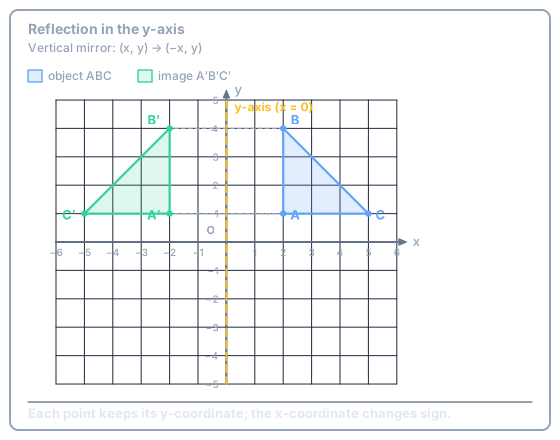
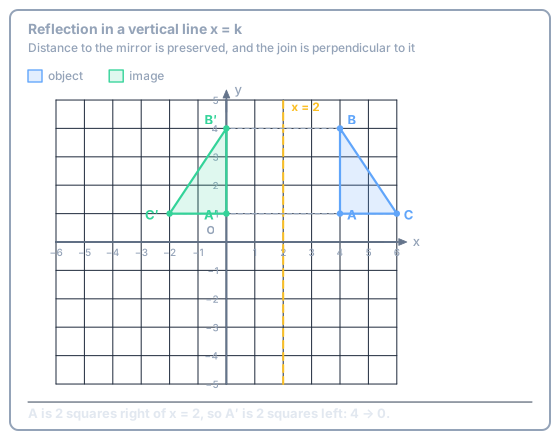
The \(y\)-axis is the line \(x = 0\). Reflection in the \(y\)-axis sends \((x, y)\) to \((-x, y)\). Reflection in \(x = k\) sends \((x, y)\) to \((2k - x, y)\).
Reflect \(A(2, 1)\), \(B(2, 4)\), \(C(5, 1)\) in the \(y\)-axis.
Reflect \(A(4, 1)\), \(B(4, 4)\), \(C(6, 1)\) in the line \(x = 2\).
Paper 2 (non-calculator)
The 0580 construction questions use horizontal or vertical mirrors. Count squares — do not guess a diagonal flip unless the question names a diagonal line.
Describing a reflection
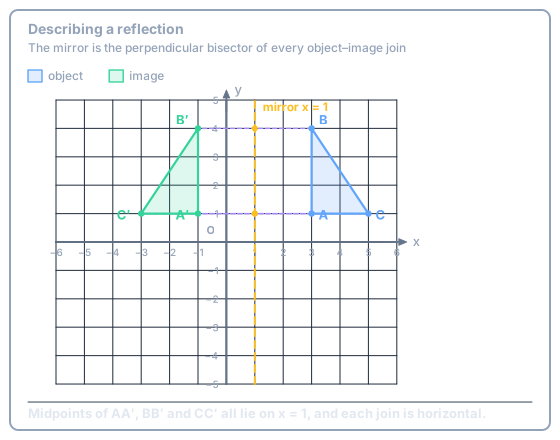
To describe a reflection you must name the mirror line (for example \(x = 1\), \(y = -2\), or the \(x\)-axis). Find it as the perpendicular bisector of the segment joining any object point to its image.
Method
- Join \(A\) to \(A'\) (and \(B\) to \(B'\) as a check).
- Mark the midpoint of \(AA'\). Repeat for \(BB'\).
- The line through those midpoints, perpendicular to the joins, is the mirror. Name it (\(x = k\) or \(y = k\)).
Triangle \(ABC\) maps to \(A'B'C'\). Describe the transformation fully.
Invariant points
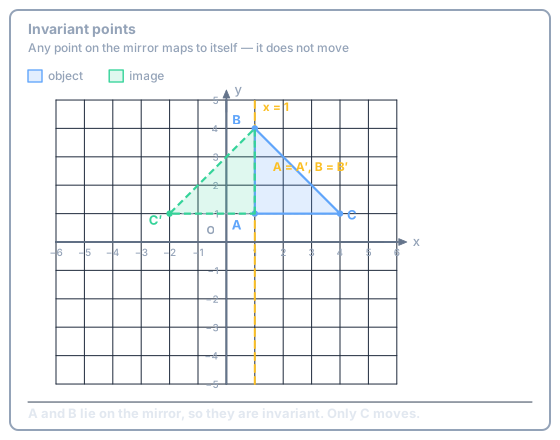
A point is invariant if it maps to itself. Under a reflection, every point on the mirror is invariant. A vertex that already lies on the mirror does not move.
Triangle \(ABC\) is reflected in \(x = 1\). \(A\) and \(B\) lie on the mirror. Which points are invariant?
Try this
Point \(P(3, -2)\) is reflected in \(y = 1\). Write the image coordinates. Then state the image of \(Q(5, 1)\) in the same mirror.
Show answer
-
Reflection in \(y = 1\): \((x, y) \to (x, 2 - y)\)
\[ P'(3, 2 - (-2)) = (3, 4) \] -
\(Q\) already lies on the mirror, so it is invariant
\[ Q' = (5, 1) \]
Exam Traps
- Describing “a reflection” without naming the mirror line loses the accuracy mark. Write \(x = 2\) or “the \(y\)-axis”, not just “vertical”.
- A point on the mirror does not move. Do not invent a new image for a vertex that already sits on the line.
0/10