Cambridge IGCSE Mathematics — 0580 Extended
Topic 7.2: Transformations — Rotation
A rotation turns a shape about a fixed centre through a given angle in a given direction (clockwise or anticlockwise). The object and image are congruent and the same orientation. 0580 rotations are through multiples of \(90^\circ\), about the origin, a vertex, or the midpoint of an edge.
\(90^\circ\) about the origin
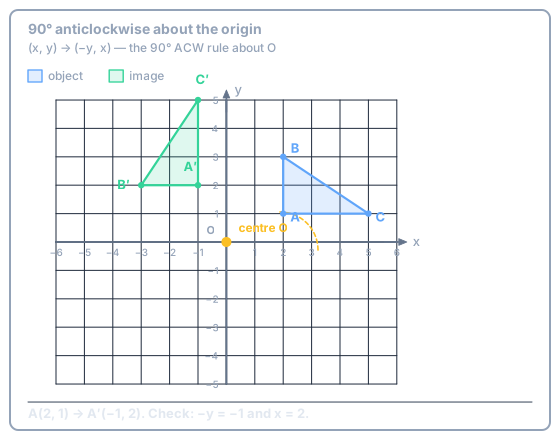
About \(O\), the coordinate rules are worth memorising.
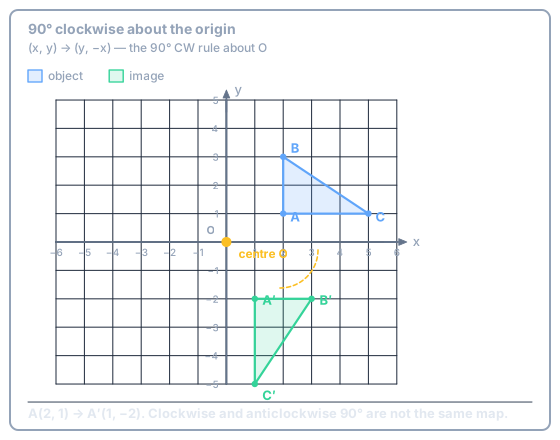
\[ 90^\circ\text{ anticlockwise: } (x, y) \to (-y, x) \qquad 90^\circ\text{ clockwise: } (x, y) \to (y, -x) \]
Method
- Mark the centre. For the origin that is \(O\).
- From the centre to a vertex, turn \(90^\circ\) in the stated direction, keeping the same distance.
- On a square grid, the vector \((a, b)\) becomes \((-b, a)\) (anticlockwise) or \((b, -a)\) (clockwise).
Rotate \(A(2, 1)\), \(B(2, 3)\), \(C(5, 1)\) through \(90^\circ\) anticlockwise about \(O\).
Rotate the same triangle \(90^\circ\) clockwise about \(O\).
\(180^\circ\) about the origin
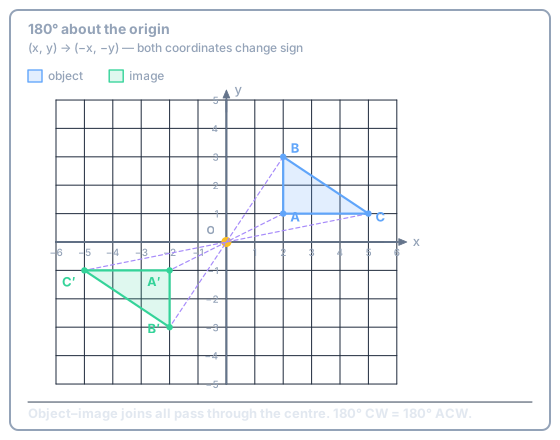
A half-turn about \(O\) sends \((x, y)\) to \((-x, -y)\). Clockwise and anticlockwise \(180^\circ\) are the same. Every object–image join passes through the centre, and the centre is the midpoint of \(AA'\).
Rotate \(A(2, 1)\), \(B(2, 3)\), \(C(5, 1)\) through \(180^\circ\) about \(O\).
Other centres
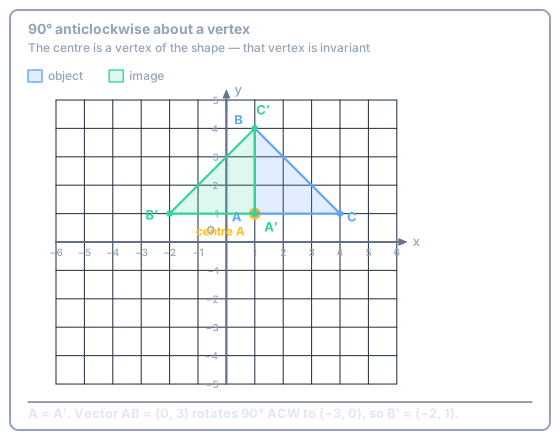
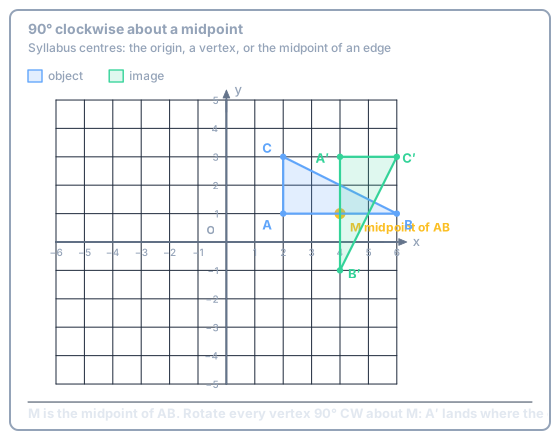
If the centre is not \(O\), rotate the vector from the centre to each vertex, then add the centre back. The centre itself is invariant.
Rotate triangle \(ABC\) through \(90^\circ\) anticlockwise about vertex \(A(1, 1)\).
Rotate triangle \(ABC\) through \(90^\circ\) clockwise about \(M\), the midpoint of \(AB\).
Describing a rotation
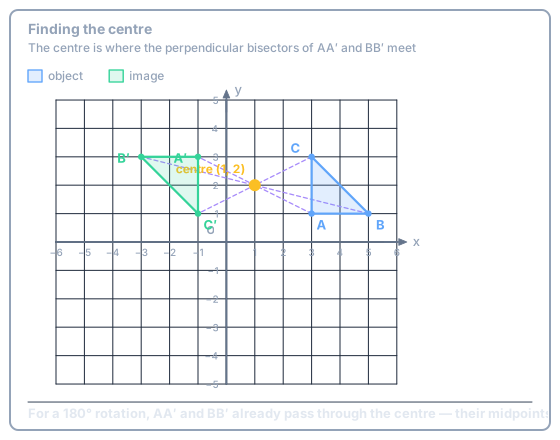
A full description needs centre, angle and direction (direction may be omitted for \(180^\circ\)). Find the centre as the intersection of the perpendicular bisectors of \(AA'\) and \(BB'\).
Object \(ABC\) maps to \(A'B'C'\). Find the centre of the rotation.
Paper 2 (non-calculator)
\(90^\circ\) anticlockwise about \(O\): swap, then change the sign of the new first coordinate. \((3, -1) \to (1, 3)\). Changing both signs is \(180^\circ\), not \(90^\circ\).
Try this
Rotate \(P(4, 1)\) through \(90^\circ\) clockwise about \(O\), then through \(180^\circ\) about \(O\). Write both images.
Show answer
-
\(90^\circ\) clockwise: \((x, y) \to (y, -x)\)
\[ (4, 1) \to (1, -4) \] -
\(180^\circ\): both signs change
\[ (4, 1) \to (-4, -1) \]
Exam Traps
- Writing “rotation \(90^\circ\)” without the centre and the direction is not a full description.
- \(90^\circ\) clockwise is not the same as \(90^\circ\) anticlockwise. Check one vertex with the coordinate rule before drawing the rest.
0/10