Cambridge IGCSE Mathematics — 0580 Extended
Topic 7.3: Transformations — Translation
A translation slides a shape without turning or flipping it. Every point moves by the same vector. On 0580 that vector is written as a column \(\binom{x}{y}\): \(x\) right (negative = left) and \(y\) up (negative = down).
Translating by a column vector
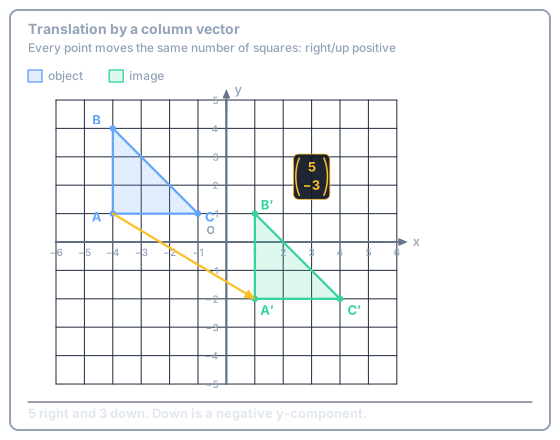
Add the vector to every vertex: \((a, b) + \binom{p}{q} = (a + p,\ b + q)\). The image is congruent to the object and the same way up.
Method
- Read the top number as squares right (or left if negative).
- Read the bottom number as squares up (or down if negative).
- Move every vertex by that same pair, then join the image.
Translate triangle \(ABC\) by \(\binom{5}{-3}\).
Reading a translation
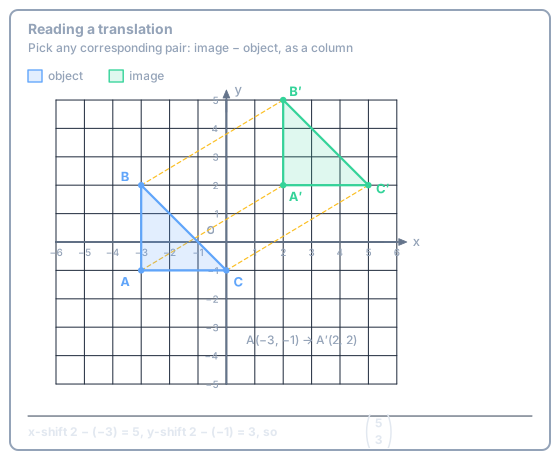
To describe a translation, give the column vector. Pick any corresponding pair: image minus object, component-wise.
\[ \binom{x_{A'} - x_A}{y_{A'} - y_A} \]
Check a second pair \(B \to B'\). If the two columns disagree, the mapping is not a translation.
\(A(-3, -1)\) maps to \(A'(2, 2)\). Write the translation vector.
Equal translations
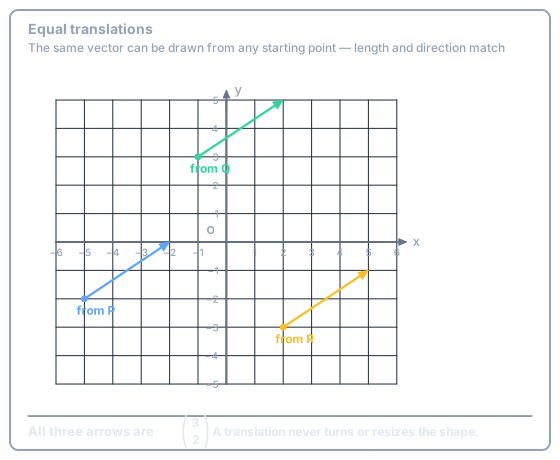
The same vector can be drawn from any starting point. Equal arrows have the same length and the same direction — they are parallel and the same sense, not just the same size.
Show that the vector \(\binom{3}{2}\) does not depend on where you start drawing it.
Paper 2 (non-calculator)
Down and left are negative. A move of 4 left and 1 up is \(\binom{-4}{1}\), not \(\binom{4}{-1}\).
The inverse translation
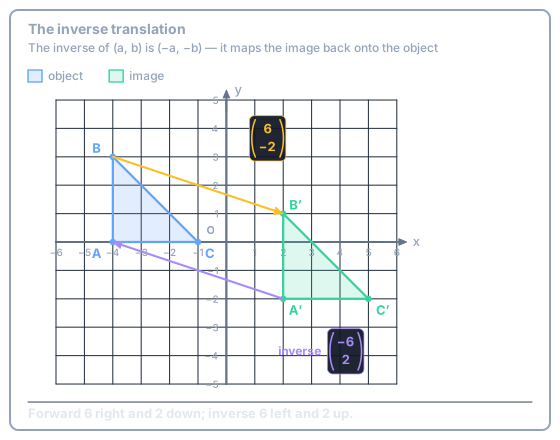
The inverse of \(\binom{p}{q}\) is \(\binom{-p}{-q}\). It maps the image back onto the object. A non-zero translation has no invariant points.
A shape is translated by \(\binom{6}{-2}\). Write the inverse translation.
Try this
\(P(1, 4)\) is translated by \(\binom{-3}{5}\) to \(P'\). Find \(P'\). Then write the vector that maps \(P'\) back to \(P\).
Show answer
-
Add the vector to \(P\)
\[ P' = (1 - 3,\ 4 + 5) = (-2,\ 9) \] -
The inverse reverses both components
\[ \binom{3}{-5} \]
0/10