Cambridge IGCSE Mathematics — 0580 Extended
Topic 7.4: Transformations — Enlargement
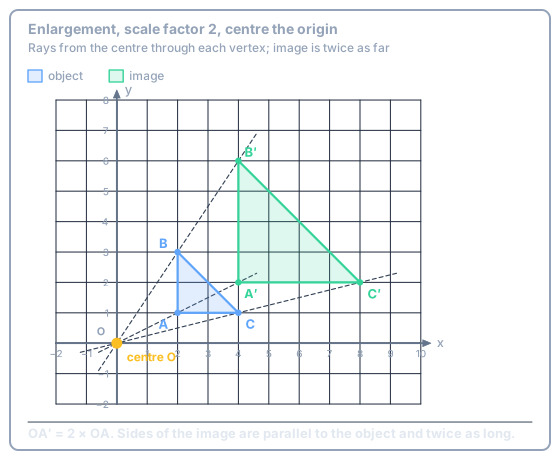
An enlargement changes size, keeping the shape. You need a centre and a scale factor \(k\). Rays from the centre through each vertex of the object also pass through the matching image vertex, and the image is \( |k| \) times as far from the centre as the object is.
Positive scale factor
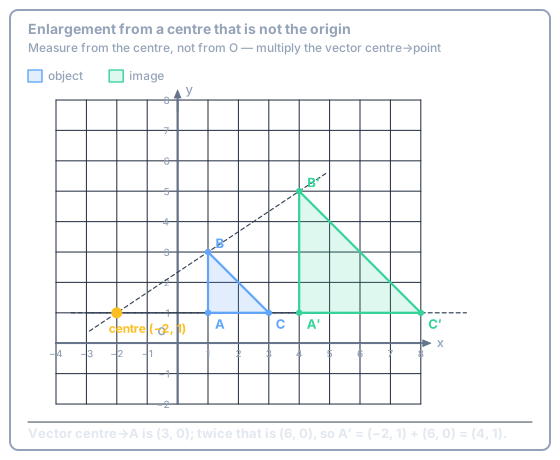
If \(k > 1\) the image is larger and further from the centre, on the same side. From the origin, \((x, y) \to (kx, ky)\). From a general centre \(C\), multiply the vector \(\overrightarrow{C\,P}\) by \(k\).
Method
- Mark the centre. Draw a ray from the centre through each vertex.
- Measure the distance centre → vertex. Multiply by \(k\) and mark that distance along the same ray.
- Join the image vertices. Sides of the image are parallel to the object.
Enlarge triangle \(ABC\) by scale factor 2 from the origin.
Enlarge triangle \(ABC\) by scale factor 2 from centre \((-2, 1)\).
Fractional scale factor
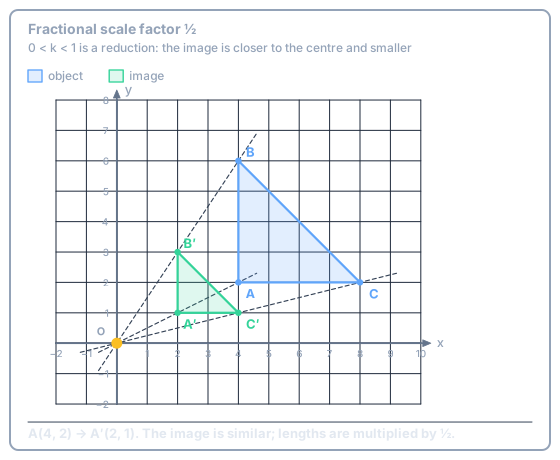
If \(0 < k < 1\) the image is a reduction: smaller, and closer to the centre, still on the same side of the centre.
Enlarge triangle \(ABC\) by scale factor \(\tfrac{1}{2}\) from the origin.
Negative scale factor
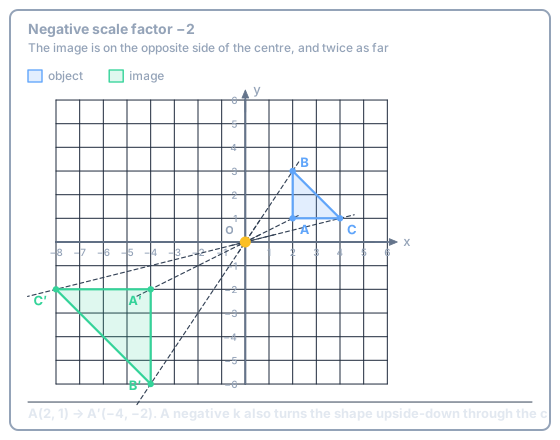
A negative \(k\) puts the image on the opposite side of the centre. Distances are still multiplied by \(|k|\), and the shape comes out inverted through the centre. From \(O\), \(k = -2\) sends \((x, y)\) to \((-2x, -2y)\).
Enlarge triangle \(ABC\) by scale factor \(-2\) from the origin.
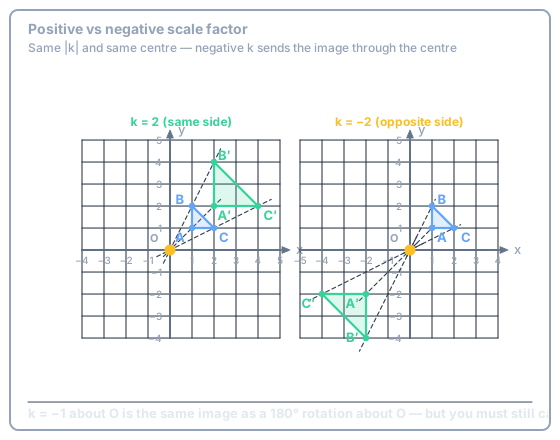
Scale factor \(-1\) about a centre is the same image as a \(180^\circ\) rotation about that centre. On 0580, if the question is in the enlargement section you still call it an enlargement, scale factor \(-1\).
Describing an enlargement
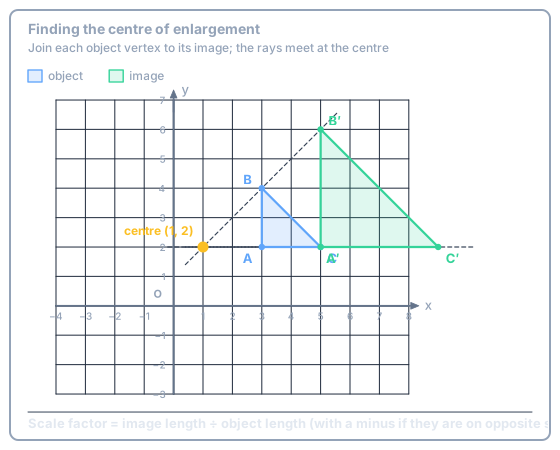
A full description needs the centre and the scale factor (with sign). Join each object vertex to its image; the rays meet at the centre. Then
\[ k = \dfrac{\text{image length}}{\text{object length}} \]
Give \(k\) a minus if object and image are on opposite sides of the centre.
Find the centre and scale factor that maps \(ABC\) onto \(A'B'C'\).
Paper 2 (non-calculator)
Count squares along a ray: if the object is 2 squares from the centre and the image is 4 squares on the same ray, \(k = 2\). If the image is 4 squares the other way, \(k = -2\).
Try this
Centre \(O\). Point \(A(3, -1)\) is enlarged by scale factor \(-2\). Write \(A'\). What scale factor maps \(A'\) back to \(A\)?
Show answer
-
Multiply both coordinates by \(-2\)
\[ A' = (-6, 2) \] -
The inverse enlargement uses \(1/k\)
\(k = -\tfrac{1}{2}\), same centre \(O\)
Exam Traps
- An enlargement is not fully described by the scale factor alone. The centre is required.
- A negative scale factor is not a rotation in the mark scheme unless the question asks for a single equivalent transformation and rotation is the intended name.
0/10