Cambridge IGCSE Mathematics — 0580 Extended
Topic 7.5: Transformations — Combined Transformations
A combined transformation is two (or more) transformations applied in order. The first-named one happens first. The result can often be rewritten as a single transformation — that is a standard 0580 ask.
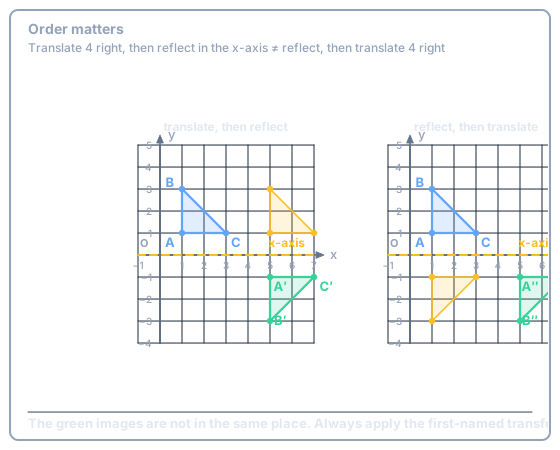
Order matters
Translation then reflection is not, in general, the same as reflection then translation. Draw the intermediate image; do not skip it.
Method
- Copy the object. Apply the first transformation; label the intermediate \(A_1B_1C_1\).
- Apply the second transformation to that intermediate, not to the original object.
- The final image is what the question means by “\(A''\)” or “the image after both”.
Compare “translate by \(\binom{4}{0}\), then reflect in the \(x\)-axis” with the reverse order.
A single equivalent transformation
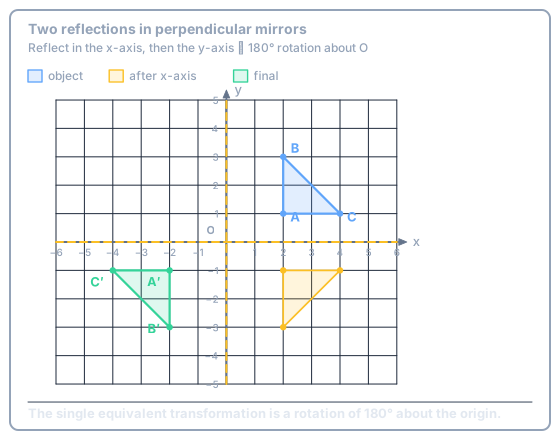
Two reflections in perpendicular mirrors through a point \(P\) are equivalent to a \(180^\circ\) rotation about \(P\). Always check by tracking one vertex, then describe the single map fully.
Reflect in the \(x\)-axis, then in the \(y\)-axis. Name the single equivalent transformation.
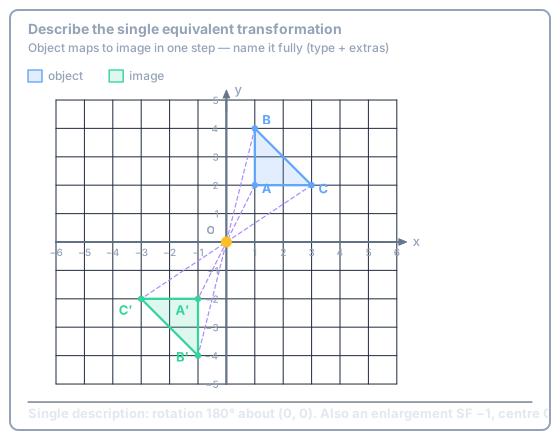
Object \(ABC\) maps to \(A'B'C'\) after two transformations. Describe the single equivalent transformation.
Inverse transformations
The inverse maps the image back onto the object.
| Transformation | Inverse |
|---|---|
| Reflection in a line | The same reflection (it undoes itself) |
| Rotation about \(C\), angle \(\theta\) ACW | Rotation about \(C\), angle \(\theta\) CW (or \(360^\circ - \theta\) ACW) |
| Translation \(\binom{p}{q}\) | Translation \(\binom{-p}{-q}\) |
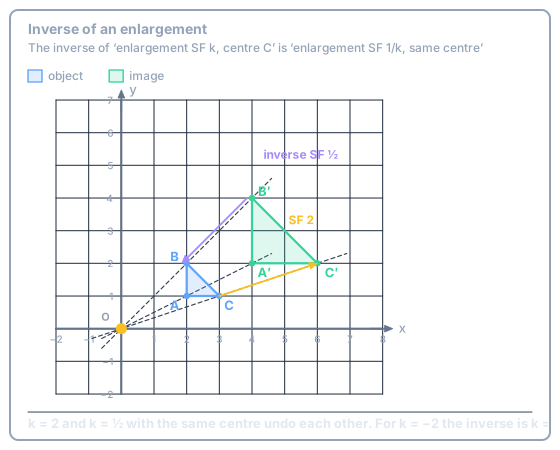
| Enlargement SF \(k\), centre \(C\) | Enlargement SF \(1/k\), same centre |
What enlargement undoes “scale factor 2, centre \(O\)”?
Invariant points and lines
An invariant point maps to itself. An invariant line maps to itself as a set (points on it may slide along it).
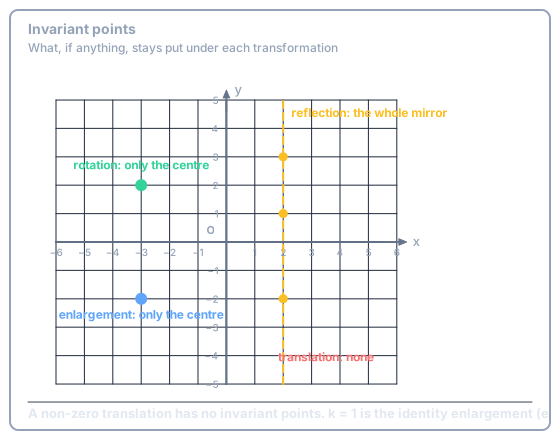
| Transformation | Invariant points |
|---|---|
| Reflection | Every point on the mirror (the whole line) |
| Rotation (angle not a multiple of \(360^\circ\)) | Only the centre |
| Enlargement (\(k \neq 1\)) | Only the centre |
| Translation (non-zero) | None |
Paper 2 (non-calculator)
Scale factor \(k = 1\) is the identity (every point invariant). Scale factor \(k = -1\) about \(C\) has the same image as a \(180^\circ\) rotation about \(C\) — only \(C\) is invariant.
Try this
A triangle is reflected in \(x = 2\), then rotated \(180^\circ\) about \(O\). Does the order matter? Name the inverse of “rotation \(90^\circ\) anticlockwise about \(O\)”.
Show answer
-
A reflection and a rotation about a different centre do not commute
order matters -
Undo a \(90^\circ\) anticlockwise turn with a \(90^\circ\) clockwise turn about the same centre
\(90^\circ\) clockwise about \(O\)
0/10