Cambridge IGCSE Mathematics — 0580 Extended
Topic 7.6: Vectors — Column Vectors
A vector has magnitude (length) and direction. On 0580 you meet column vectors \(\binom{x}{y}\), the directed segment \(\overrightarrow{AB}\), and bold (or underlined) letters such as \(\mathbf{a}\).
Drawing a column vector
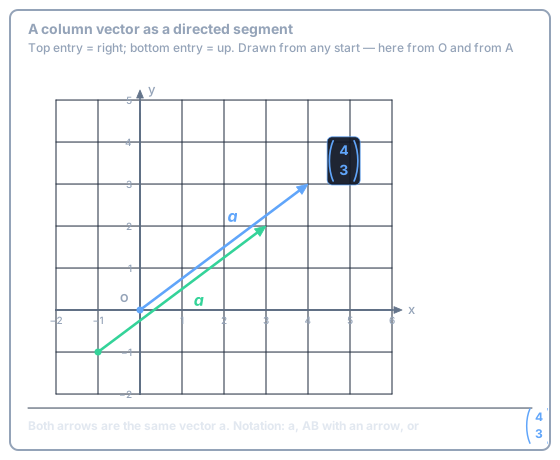
\(\binom{x}{y}\) means \(x\) right and \(y\) up, drawn as an arrow. The same column can start anywhere — only the displacement matters, not the position on the grid.
Draw \(\mathbf{a} = \binom{4}{3}\) from the origin and from another point.
Addition — the triangle law
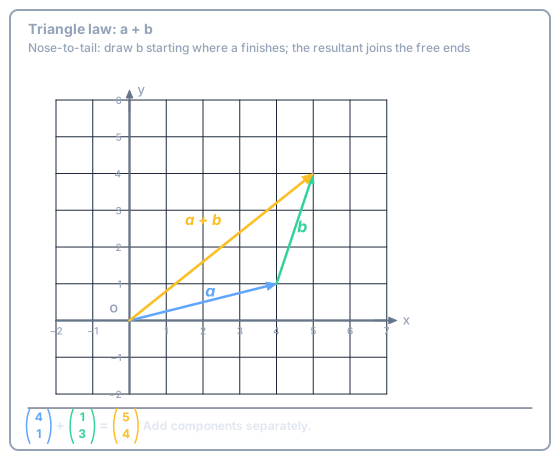
To add \(\mathbf{a} + \mathbf{b}\), draw \(\mathbf{b}\) starting where \(\mathbf{a}\) finishes (nose to tail). The resultant joins the free start of \(\mathbf{a}\) to the free end of \(\mathbf{b}\). Components add:
\[ \binom{p}{q} + \binom{r}{s} = \binom{p + r}{q + s} \]
Add \(\binom{4}{1}\) and \(\binom{1}{3}\) on a grid.
Subtraction and scalars
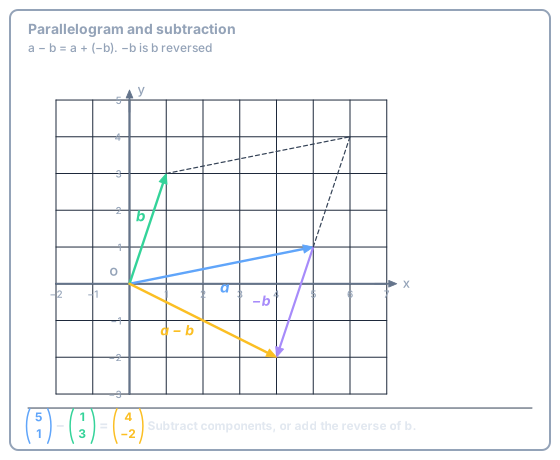
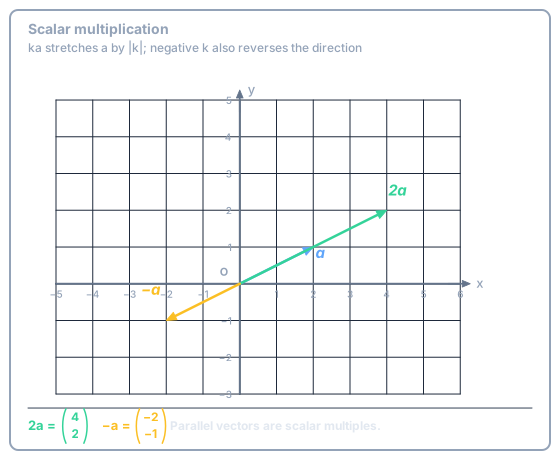
\(\mathbf{a} - \mathbf{b} = \mathbf{a} + (-\mathbf{b})\). The vector \(-\mathbf{b}\) has the same length as \(\mathbf{b}\) and the opposite direction. Scalar multiplication \(k\mathbf{a}\) stretches by \(|k|\) and reverses direction when \(k\) is negative.
\[ k\binom{x}{y} = \binom{kx}{ky} \]
On a grid, show \(\mathbf{a} - \mathbf{b}\) as \(\mathbf{a}\) plus the reverse of \(\mathbf{b}\).
Draw \(\mathbf{a}\), \(2\mathbf{a}\) and \(-\mathbf{a}\).
Magnitude
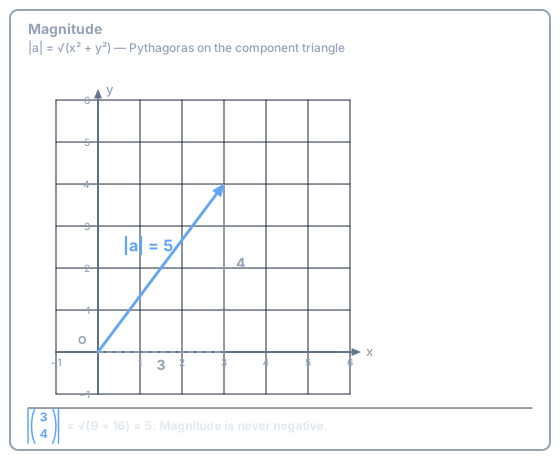
The magnitude (modulus) of \(\binom{x}{y}\) is the length of the arrow, from Pythagoras:
\[ \left|\binom{x}{y}\right| = \sqrt{x^2 + y^2} \]
Magnitude is never negative. Leave surds exact on Paper 2 unless a decimal is asked for.
Find the magnitude of \(\binom{3}{4}\).
Paper 2 (non-calculator)
\(\left|\binom{5}{12}\right| = \sqrt{25 + 144} = \sqrt{169} = 13\). Recognise the 3-4-5 and 5-12-13 triangles from Topic 6.1.
Equal and parallel
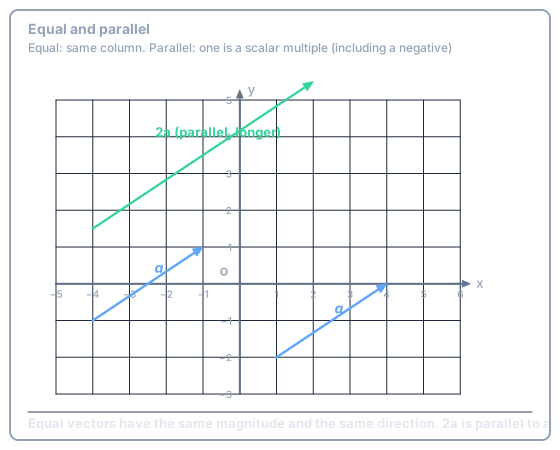
Equal vectors have the same column — same magnitude and the same direction. Parallel vectors are scalar multiples: \(\mathbf{b} = k\mathbf{a}\) for some \(k \neq 0\). If \(k < 0\) they are parallel but opposite in sense.
Show two equal copies of \(\mathbf{a}\), and a parallel vector \(2\mathbf{a}\).
Try this
\(\mathbf{p} = \binom{6}{-8}\). Write \(\tfrac{1}{2}\mathbf{p}\) and \(|\mathbf{p}|\). Is \(\binom{-3}{4}\) parallel to \(\mathbf{p}\)?
Show answer
-
Halve each component; magnitude uses Pythagoras
\[ \tfrac{1}{2}\mathbf{p} = \binom{3}{-4},\quad |\mathbf{p}| = \sqrt{36 + 64} = 10 \] -
\(\binom{-3}{4} = -\tfrac{1}{2}\binom{6}{-8}\), so yes — parallel, opposite sense
\[ \binom{-3}{4} = -\tfrac{1}{2}\mathbf{p} \]
0/10