Cambridge IGCSE Mathematics — 0580 Extended
Topic 7.7: Vectors — Vector Geometry
Vector geometry on 0580 is the art of writing a required vector in terms of two given ones, usually \(\mathbf{a}\) and \(\mathbf{b}\), using a labelled diagram. The working is algebraic; the diagram tells you which route to write.
Position vectors and \(\overrightarrow{AB} = \mathbf{b} - \mathbf{a}\)
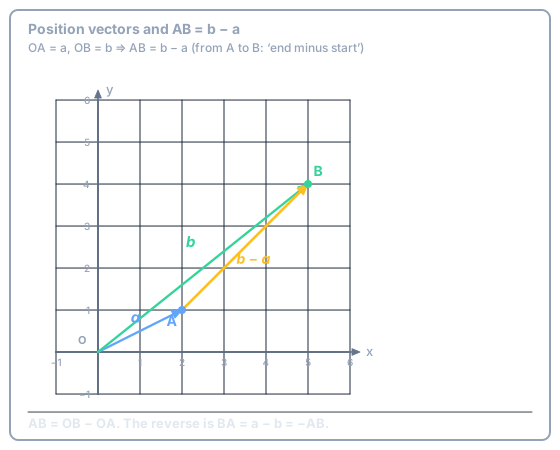
The position vector of a point \(A\) is \(\overrightarrow{OA} = \mathbf{a}\), from a fixed origin. For two points,
\[ \overrightarrow{AB} = \mathbf{b} - \mathbf{a} \]
End minus start. The reverse is \(\overrightarrow{BA} = \mathbf{a} - \mathbf{b} = -\overrightarrow{AB}\).
Method
- Write a route from the start point to the end point, via the origin if needed: \(A \to O \to B\).
- \(A \to O\) is \(-\mathbf{a}\) and \(O \to B\) is \(\mathbf{b}\), so \(\overrightarrow{AB} = -\mathbf{a} + \mathbf{b}\).
- Simplify. Check the arrow goes from \(A\) to \(B\), not the other way.
\(OA = \mathbf{a}\) and \(OB = \mathbf{b}\). Express \(\overrightarrow{AB}\) in terms of \(\mathbf{a}\) and \(\mathbf{b}\).
Parallelograms
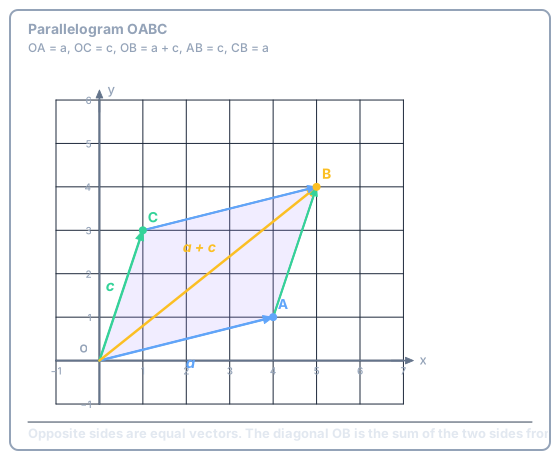
In parallelogram \(OABC\) with \(\overrightarrow{OA} = \mathbf{a}\) and \(\overrightarrow{OC} = \mathbf{c}\), the opposite sides are equal vectors and the diagonal from \(O\) is the sum.
\[ \overrightarrow{OB} = \mathbf{a} + \mathbf{c},\quad \overrightarrow{AB} = \mathbf{c},\quad \overrightarrow{CB} = \mathbf{a} \]
Label the sides and the diagonal of parallelogram \(OABC\) in terms of \(\mathbf{a}\) and \(\mathbf{c}\).
Midpoints and the section formula
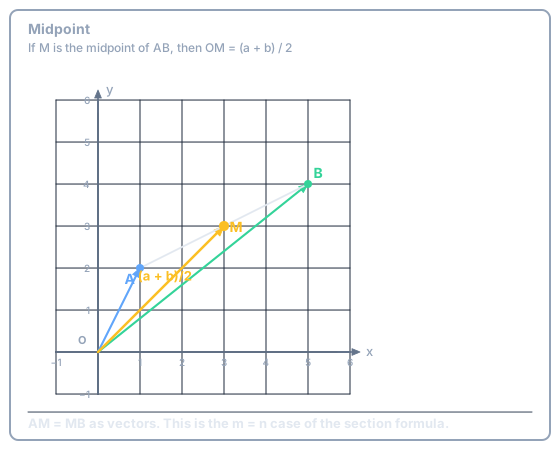
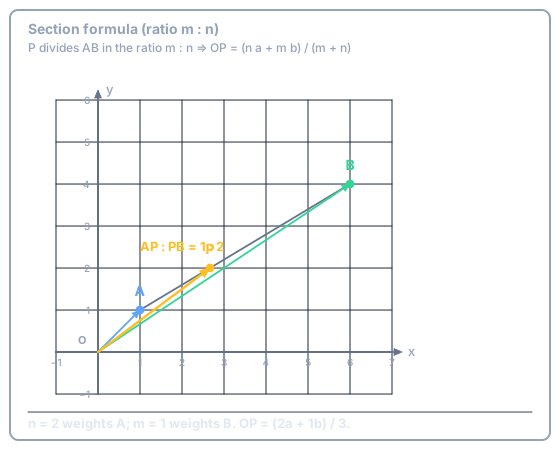
If \(M\) is the midpoint of \(AB\), then \(\overrightarrow{OM} = \dfrac{\mathbf{a} + \mathbf{b}}{2}\). More generally, if \(P\) divides \(AB\) in the ratio \(m : n\) (so \(AP : PB = m : n\)),
\[ \overrightarrow{OP} = \frac{n\mathbf{a} + m\mathbf{b}}{m + n} \]
The \(n\) weights \(A\) and the \(m\) weights \(B\) — the larger weight sits on the nearer endpoint.
\(M\) is the midpoint of \(AB\). Write \(\overrightarrow{OM}\).
\(P\) divides \(AB\) in the ratio \(1 : 2\). Write \(\overrightarrow{OP}\).
Parallel and collinear
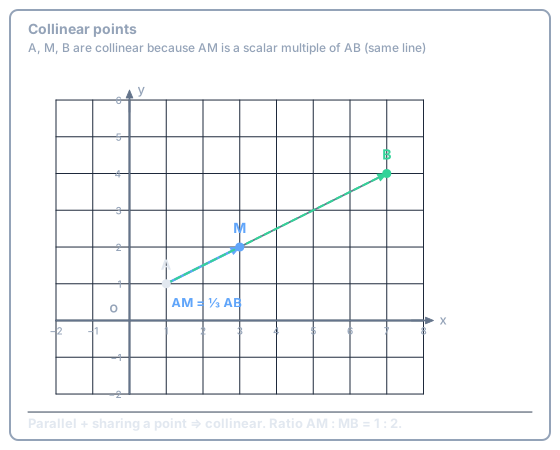
Two vectors are parallel when one is a scalar multiple of the other. Points \(A\), \(M\) and \(B\) are collinear when \(\overrightarrow{AM}\) is a scalar multiple of \(\overrightarrow{AB}\) (and they share the point \(A\)).
Show that \(M\) lies on \(AB\) when \(\overrightarrow{AM} = \tfrac{1}{3}\overrightarrow{AB}\).
A typical exam diagram
Stay with the letters on the diagram. Write a route, substitute the given vectors, and simplify. Do not invent a coordinate grid unless the question gives one.
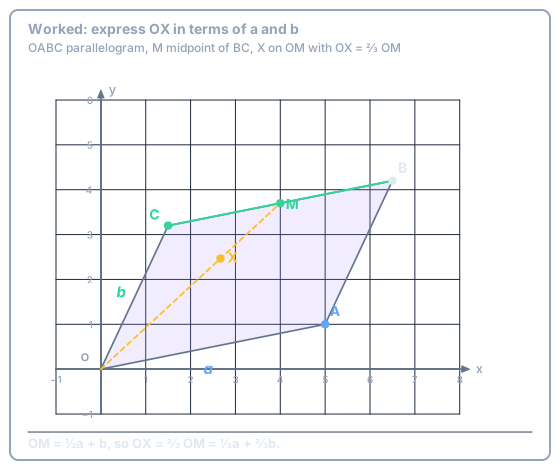
\(OABC\) is a parallelogram with \(\overrightarrow{OA} = \mathbf{a}\) and \(\overrightarrow{OC} = \mathbf{b}\). \(M\) is the midpoint of \(BC\), and \(X\) lies on \(OM\) with \(\overrightarrow{OX} = \tfrac{2}{3}\overrightarrow{OM}\). Express \(\overrightarrow{OX}\) in terms of \(\mathbf{a}\) and \(\mathbf{b}\).
Paper 2 (non-calculator)
Keep fractions: \(\tfrac{1}{2}\mathbf{a} + \mathbf{b}\), then \(\tfrac{2}{3}\) of that is \(\tfrac{1}{3}\mathbf{a} + \tfrac{2}{3}\mathbf{b}\). Do not decimalise.
Try this
In the same parallelogram, write \(\overrightarrow{AM}\) in terms of \(\mathbf{a}\) and \(\mathbf{b}\).
Show answer
-
\(\overrightarrow{OA} = \mathbf{a}\), \(\overrightarrow{OM} = \tfrac{1}{2}\mathbf{a} + \mathbf{b}\)
\[ \overrightarrow{AM} = \overrightarrow{OM} - \overrightarrow{OA} = \left(\tfrac{1}{2}\mathbf{a} + \mathbf{b}\right) - \mathbf{a} \] -
Simplify
\[ \overrightarrow{AM} = -\tfrac{1}{2}\mathbf{a} + \mathbf{b} \]
Exam Traps
- \(\overrightarrow{AB}\) is end minus start: \(\mathbf{b} - \mathbf{a}\), not \(\mathbf{a} - \mathbf{b}\). The wrong way round is the standard sign error.
- Parallel is not the same as equal. \(2\mathbf{a}\) is parallel to \(\mathbf{a}\); it is not equal to \(\mathbf{a}\).
0/10