Cambridge IGCSE Mathematics — 0580 Extended
Topic 8.1: Probability — Introduction
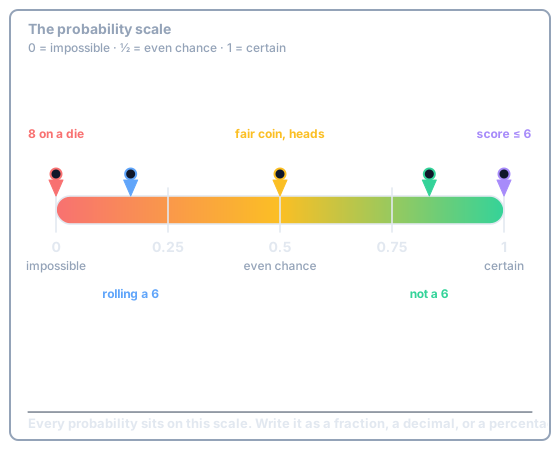
Probability measures how likely an event is, on a scale from \(0\) (impossible) to \(1\) (certain). On Extended 0580 you write \(\mathrm{P}(A)\) for the probability of \(A\), and \(\mathrm{P}(A')\) for the probability that \(A\) does not happen. Give the answer as a fraction, a decimal or a percentage — the question will usually signal which.
The probability scale
An event that is as likely as not sits at \(0.5\). Nothing lives outside \([0, 1]\): a working of \(1.2\) or of \(-0.1\) has already gone wrong.
Equally likely outcomes
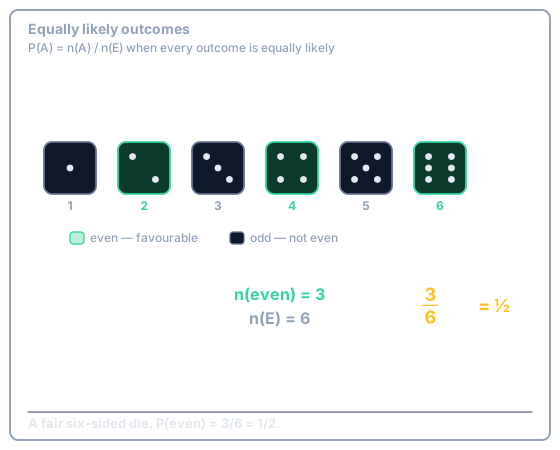
When every outcome of an experiment is equally likely,
\[ \mathrm{P}(A) = \dfrac{n(A)}{n(\mathcal{E})} \]
Favourable outcomes on top, equally likely outcomes in the whole sample space \(\mathcal{E}\) on the bottom.
Method
- List the sample space, or count it (\(n(\mathcal{E})\)).
- Count the outcomes that match the event (\(n(A)\)).
- Write the fraction and cancel if you can.
A fair six-sided die is rolled. Find \(\mathrm{P}(\text{even})\).
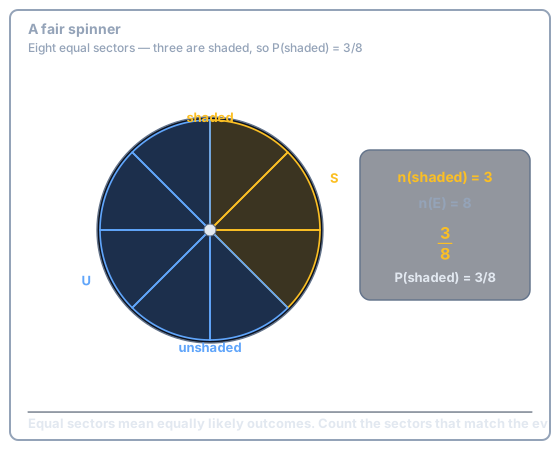
A fair spinner is split into eight equal sectors. Three sectors are shaded. Find \(\mathrm{P}(\text{shaded})\).
Notation and a bag of counters
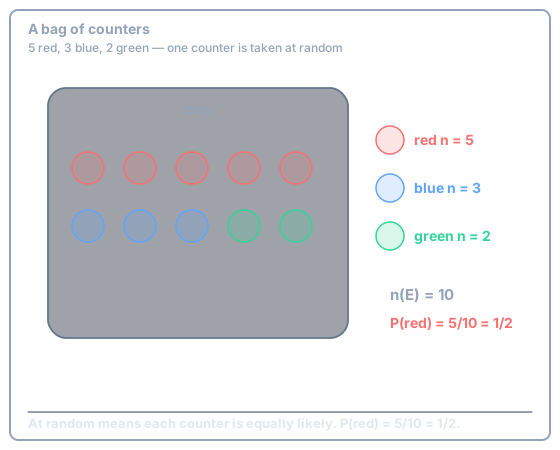
Extended papers use \(\mathrm{P}(A)\) and \(\mathrm{P}(A')\). “At random” means each counter (or card, or student) is equally likely.
A bag contains 5 red, 3 blue and 2 green counters. One is taken at random. Find \(\mathrm{P}(\text{red})\).
The complement
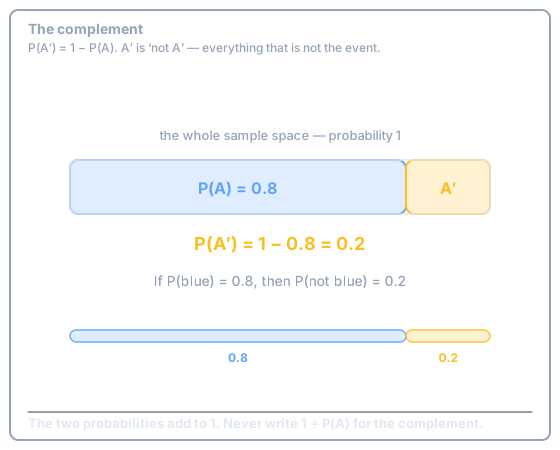
\(A'\) is “not \(A\)”. The two events split the whole sample space:
\[ \mathrm{P}(A') = 1 - \mathrm{P}(A) \]
\(\mathrm{P}(B) = 0.8\). Find \(\mathrm{P}(B')\).
Paper 2 (non-calculator)
Leave a complement as a fraction: if \(\mathrm{P}(A) = 3/8\), then \(\mathrm{P}(A') = 5/8\). Do not convert unless the question asks for a decimal or a percentage.
Try this
A fair spinner has 5 equal sectors; 2 are red. Find \(\mathrm{P}(\text{not red})\).
Show answer
-
\(\mathrm{P}(\text{red}) = 2/5\)
\[ \mathrm{P}(\text{not red}) = 1 - \dfrac{2}{5} = \dfrac{3}{5} \]
Exam Traps
- \(\mathrm{P}(A')\) is \(1 - \mathrm{P}(A)\), not \(1/\mathrm{P}(A)\). The reciprocal is a different (and usually illegal) number.
0/10