Cambridge IGCSE Mathematics — 0580 Extended
Topic 8.3: Probability — Combined Events
Two experiments at once — two coins, a coin and a die, two dice — need a sample space: a complete list (or grid) of equally likely outcomes. Count the matching cells, then divide by the total. Extended papers also distinguish with replacement from without replacement.
Listing a sample space
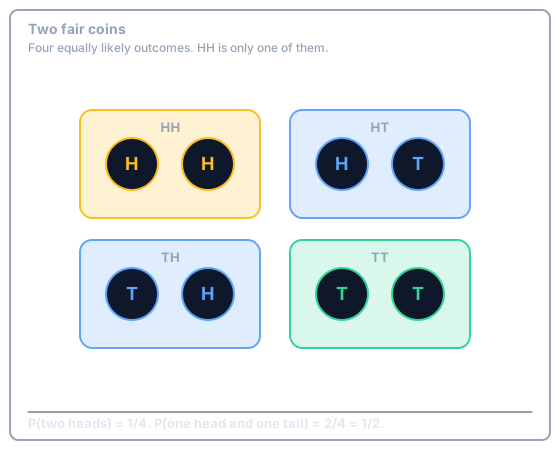
Write every equally likely outcome once. Two coins give four, not three: HT and TH are different.
Two fair coins are flipped. Find \(\mathrm{P}(\text{two heads})\) and \(\mathrm{P}(\text{one of each})\).
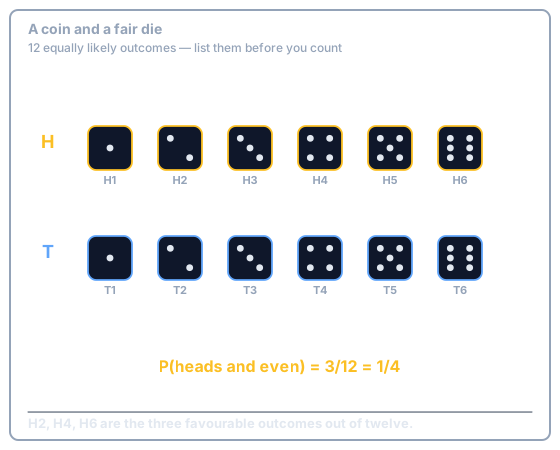
A fair coin and a fair die are used together. Find \(\mathrm{P}(\text{heads and even})\).
Two dice
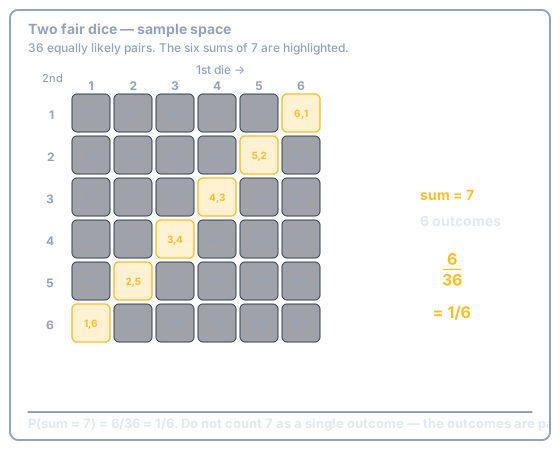
A \(6 \times 6\) grid has 36 equally likely pairs. The outcomes are the pairs, not the sums. “A total of 7” is six cells, not one.
Two fair dice are rolled. Find \(\mathrm{P}(\text{sum} = 7)\).
AND and OR
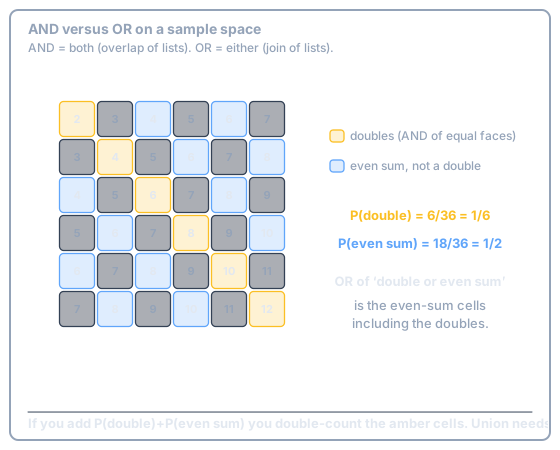
AND means both: count the overlap of the two lists. OR means either: join the lists, but do not count a cell twice. Adding two probabilities that share outcomes double-counts the overlap.
On two dice, contrast doubles with an even sum.
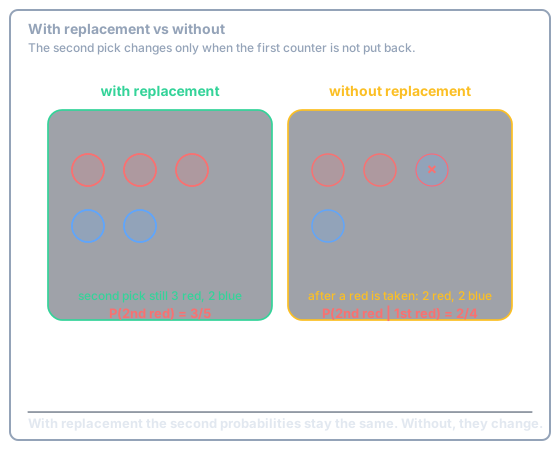
With replacement or without
If the first counter is put back, the bag is unchanged and the second probabilities stay the same. If it is not put back, the denominator (and often the numerator) changes. Trees in the next topic make this automatic; the bag picture is the reason.
Paper 2 (non-calculator)
Keep 36 in the denominator until the last line, then cancel: \(6/36 = 1/6\). Do not write \(0.166\ldots\) on Paper 2.
Try this
Two fair dice are rolled. Find \(\mathrm{P}(\text{both the same})\).
Show answer
-
Doubles: (1,1), (2,2), …, (6,6) — six pairs out of 36
\[ \mathrm{P}(\text{both the same}) = \dfrac{6}{36} = \dfrac{1}{6} \]
Exam Traps
- HT and TH are different outcomes. Collapsing them into “one head and one tail” before you count will make \(\mathrm{P}(\text{HH})\) look like \(1/3\).
0/10