Cambridge IGCSE Mathematics — 0580 Extended
Topic 8.4: Probability — Tree Diagrams
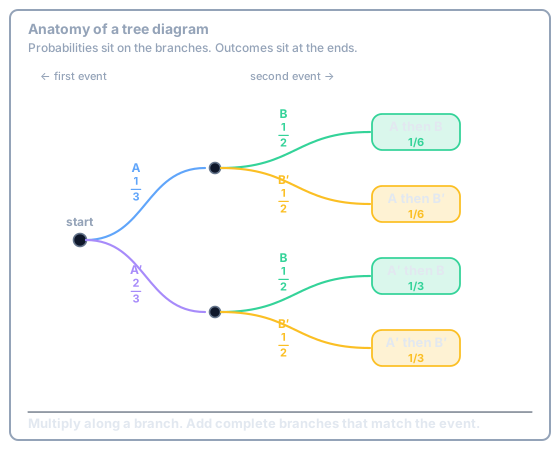
A tree splits each stage of an experiment into branches. On 0580, probabilities sit by the side of the branches and outcomes sit at the ends. Combined events may be with or without replacement. Two rules run the whole topic: multiply along a branch, add complete branches that match the event.
How to draw a tree
First event on the left, second event from each of those ends. The probabilities on branches that leave the same point must add to 1.
Method
- Draw the first split. Label each branch with its probability.
- From every first-event end, draw the second split. Without replacement, change those fractions.
- Write the outcome at each far end. Multiply along the route to get that end’s probability.
- Add the ends that match the event you want.
With replacement
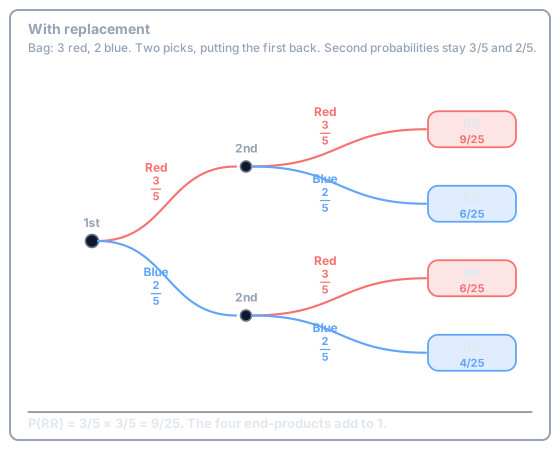
The first counter is put back, so the second fractions copy the first.
A bag has 3 red and 2 blue counters. Two are taken at random, replacing the first. Find \(\mathrm{P}(\text{RR})\).
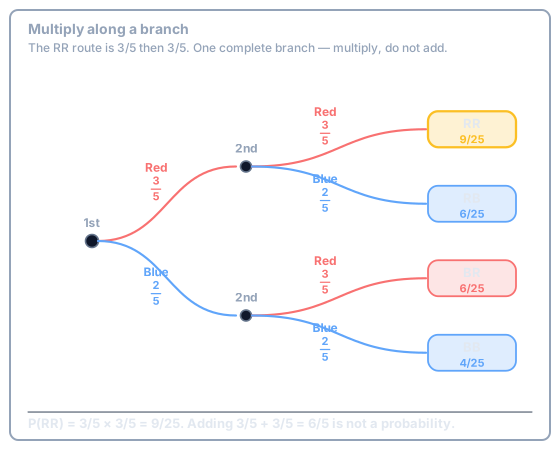
On that tree, show the RR route.
Without replacement
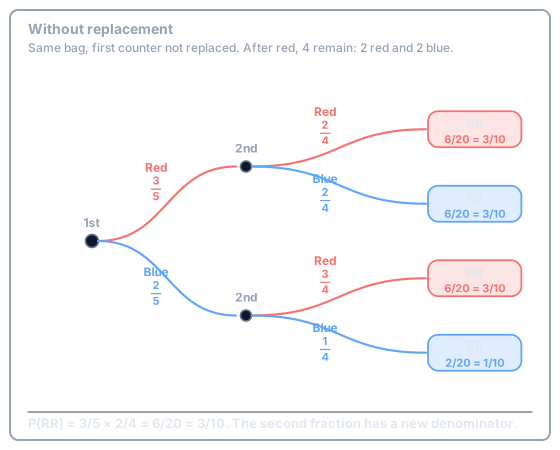
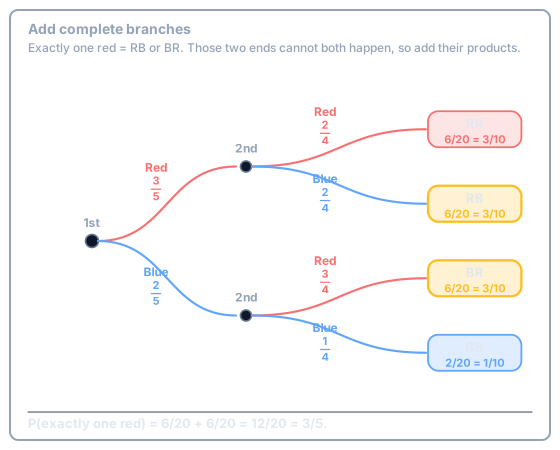
The first counter stays out. After red, 4 remain: 2 red and 2 blue, so the next red is \(2/4\), not \(3/5\).
The same bag, but the first counter is not replaced. Find \(\mathrm{P}(\text{RR})\).
Add the matching ends
“Exactly one red” is the RB end or the BR end. Those two complete outcomes cannot both happen, so add their products.
Without replacement, find \(\mathrm{P}(\text{exactly one red})\).
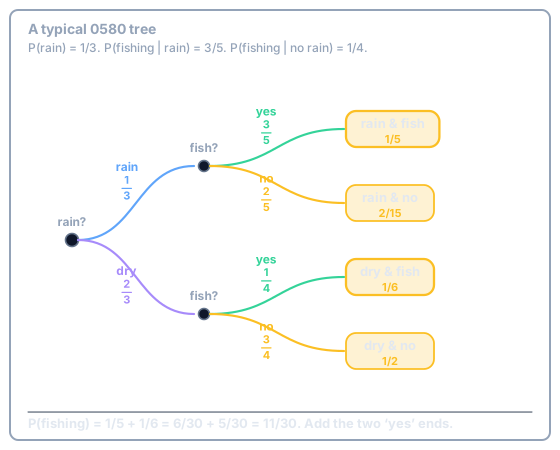
On any day, \(\mathrm{P}(\text{rain}) = 1/3\). If it rains, \(\mathrm{P}(\text{fishing}) = 3/5\); if it is dry, \(\mathrm{P}(\text{fishing}) = 1/4\). Find \(\mathrm{P}(\text{fishing})\).
Paper 2 (non-calculator)
Write products unsimplified first if that helps the add: \(1/5 + 1/6\) needs a common denominator 30. Do not decimalise \(11/30\).
Try this
With the 3-red, 2-blue bag and replacement, find \(\mathrm{P}(\text{same colour})\).
Show answer
-
Same colour is RR or BB
\[ \mathrm{P}(\text{RR}) + \mathrm{P}(\text{BB}) = \dfrac{9}{25} + \dfrac{4}{25} = \dfrac{13}{25} \]
Exam Traps
- Multiply along a branch; add complete branches. Adding the two fractions on one route (for example \(3/5 + 3/5\)) is the standard tree error.
0/10