Cambridge IGCSE Mathematics — 0580 Extended
Topic 8.5: Probability — Venn Diagrams
A two-set Venn splits \(\mathcal{E}\) into four regions. Fill the regions with counts (or probabilities that already add to 1), then the probability of a set is (total in the matching regions) \(\div n(\mathcal{E})\). Extended papers may use \(\mathrm{P}(A \cap B)\) and \(\mathrm{P}(A \cup B)\).
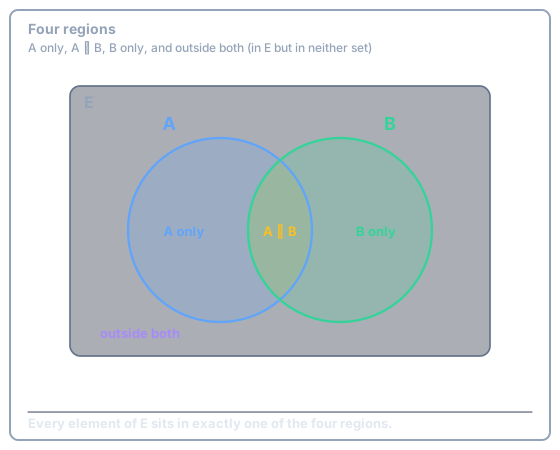
Four regions
A only, \(A \cap B\), B only, and outside both. Every person or object sits in exactly one of those four.
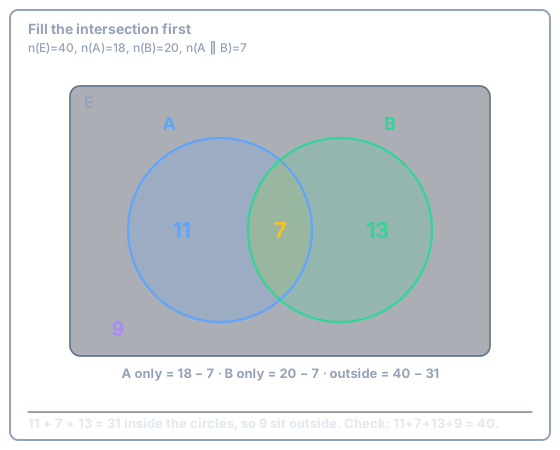
Fill the intersection first
\(n(A)\) includes the overlap. So A only \(= n(A) - n(A \cap B)\). The outside is whatever is left of \(n(\mathcal{E})\).
Method
- Write the intersection in the overlap.
- A only \(= n(A) - n(A \cap B)\). Same for B.
- Add the three inner regions. Outside \(= n(\mathcal{E}) -\) that total.
- Check the four numbers sum to \(n(\mathcal{E})\).
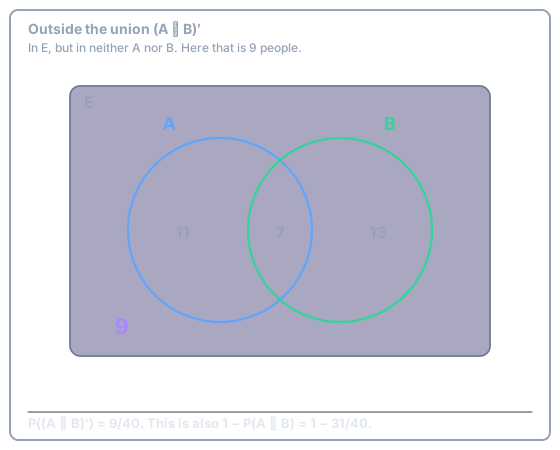
\(n(\mathcal{E}) = 40\), \(n(A) = 18\), \(n(B) = 20\), \(n(A \cap B) = 7\). Complete the Venn.
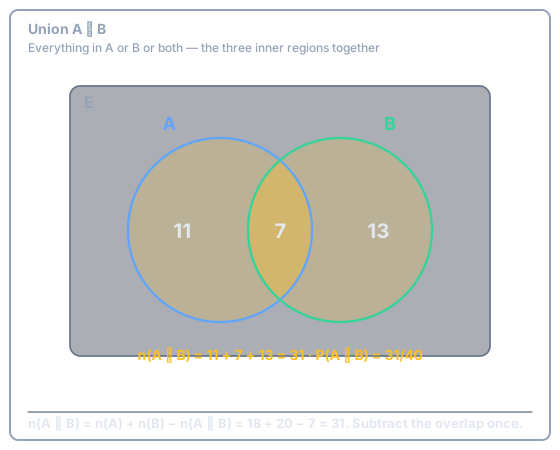
Union, intersection, complement
\[ n(A \cup B) = n(A) + n(B) - n(A \cap B) \]
Subtract the overlap once. Then \(\mathrm{P}(A \cup B) = n(A \cup B)/n(\mathcal{E})\).
Using the completed Venn, find \(\mathrm{P}(A \cup B)\).
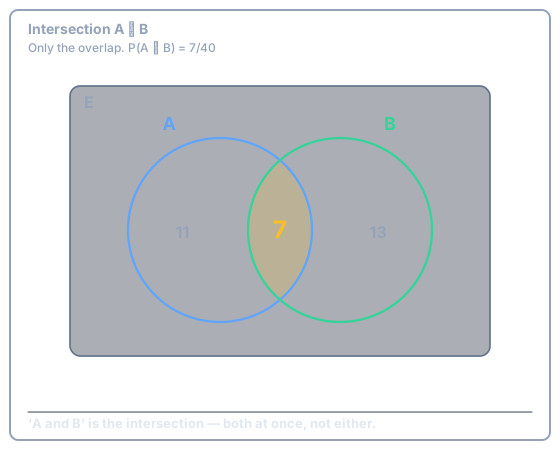
Find \(\mathrm{P}(A \cap B)\).
Find \(\mathrm{P}((A \cup B)')\).
Read the region
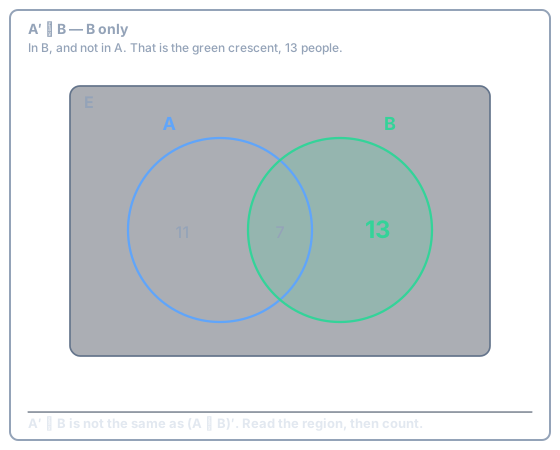
\(A' \cap B\) is B only — in B, and not in A. It is not the complement of the intersection.
Find \(\mathrm{P}(A' \cap B)\).
Paper 2 (non-calculator)
Leave probabilities over 40: \(31/40\), \(7/40\), \(13/40\). Cancel only when it is obvious, for example \(20/40 = 1/2\).
Try this
On the same Venn, find \(\mathrm{P}(A')\).
Show answer
-
\(A'\) is everything not in A: B only + outside = 13 + 9
\[ \mathrm{P}(A') = \dfrac{22}{40} = \dfrac{11}{20} \quad\text{or}\quad 1 - \dfrac{18}{40} = \dfrac{22}{40} \]
Exam Traps
- \(n(A) + n(B)\) counts the overlap twice. For the union, subtract \(n(A \cap B)\) once — or add the three inner regions from the completed Venn.
0/10