Cambridge IGCSE Mathematics — 0580 Extended
Topic 8.6: Probability — Conditional Probability
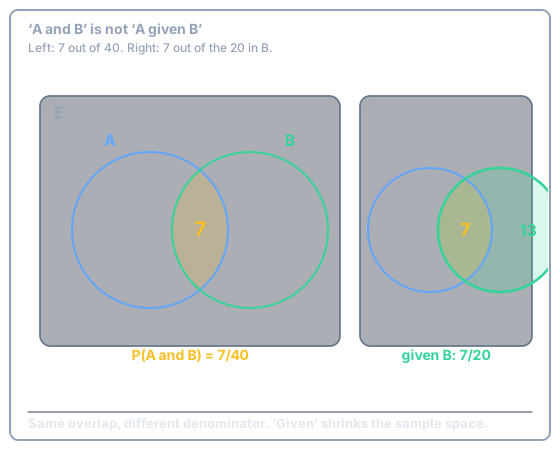
“Given B” means the sample space has shrunk to B. You no longer divide by \(n(\mathcal{E})\). On 0580 you do this from a Venn, a tree or a table — the papers do not require the notation \(\mathrm{P}(A \mid B)\) or a formula sheet identity. Read the word given, restrict, then count.
From a Venn
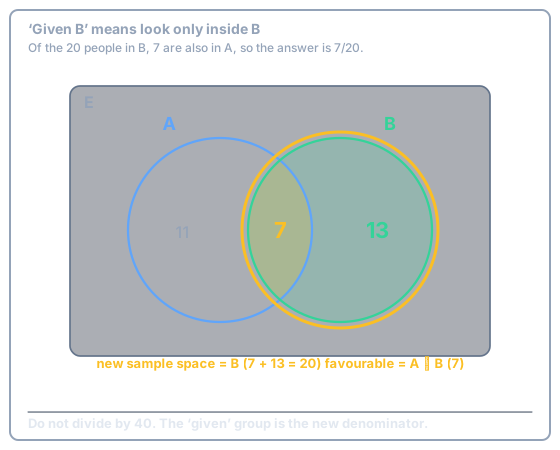
Given B, look only inside circle B. Favourable means the overlap \(A \cap B\). Denominator is \(n(B)\), not \(n(\mathcal{E})\).
Method
- Underline the given set. That circle (or row, or first branch) is the new whole.
- Count how many of those also match the other event.
- Write (both) \(\div\) (given group).
From the Venn with \(n(B) = 20\) and \(n(A \cap B) = 7\): a person is chosen at random from those in B. Find the probability they are also in A.
From a tree
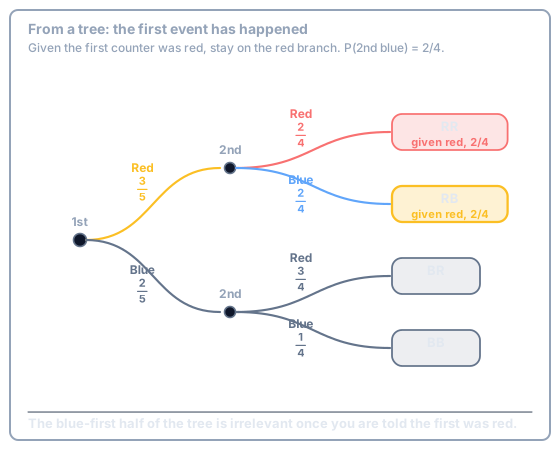
If you are told the first event has happened, stay on that first branch. The second-stage fraction on that branch is already the conditional probability.
A bag has 3 red and 2 blue. Two counters are taken without replacement. Given the first was red, find the probability the second is blue.
From a two-way table
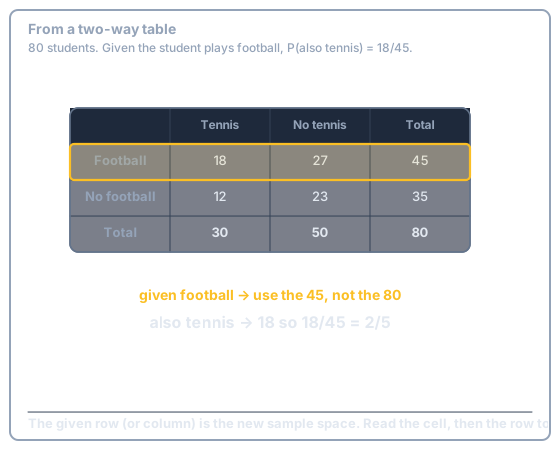
The given row (or column) is the new sample space. Read the cell, then the row total.
80 students. 45 play football, 30 play tennis, 18 play both. A student is chosen at random from those who play football. Find the probability they also play tennis.
Without replacement is already conditional
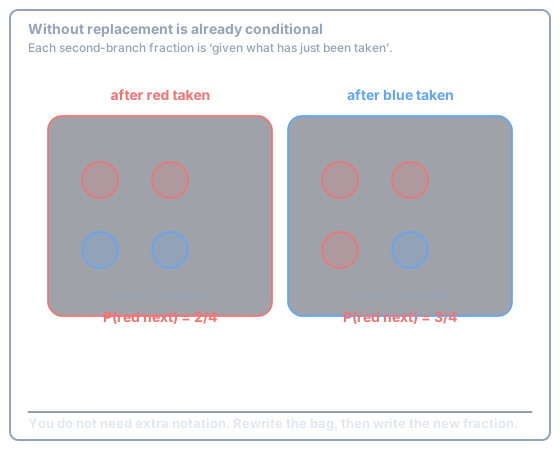
Each second-branch fraction is “given what has just been taken”. You do not need extra notation: redraw the bag, then write the new fraction.
Why is “A and B” different from “A given B”?
Paper 2 (non-calculator)
\(18/45 = 2/5\) by cancelling 9. The given total is the denominator — cancelling does not change that fact.
Try this
From the football/tennis table, a student is chosen from those who play tennis. Find the probability they play football.
Show answer
-
Given tennis → column total 30. Football and tennis → 18
\[ \dfrac{18}{30} = \dfrac{3}{5} \]
Exam Traps
- The word given changes the denominator. Dividing by the whole of \(\mathcal{E}\) (40, or 80, or 5/5) is the mark lost on almost every conditional question.
0/10