Cambridge IGCSE Mathematics — 0580 Extended
Topic 9.3: Statistics — Averages and Spread
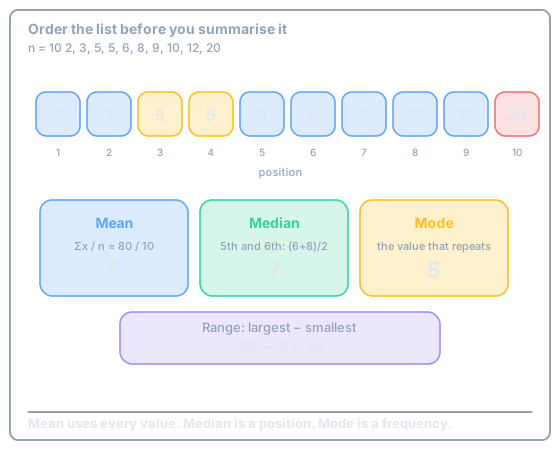
For a raw list, Extended 0580 wants the mean, median, mode, quartiles, range and interquartile range, and a reason for which average you used. Order the list first. The mean uses every value; the median is a position; the mode is a frequency.
Mean, median, mode, range
Mean \(= \Sigma x / n\). Median: middle value, or the mean of the two middle values when \(n\) is even. Mode: the value that appears most. Range \(=\) largest \(-\) smallest.
Method
- Order the list. Count \(n\).
- Mean: add, then divide by \(n\).
- Median: position \((n+1)/2\). If that is halfway between two values, average them.
- Mode and range from the ordered list.
For 2, 3, 5, 5, 6, 8, 9, 10, 12, 20 find the mean, median, mode and range.
Quartiles and IQR
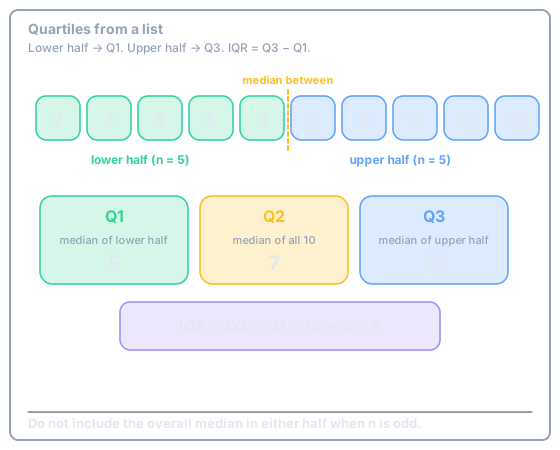
Split the ordered list in half. \(Q_1\) is the median of the lower half; \(Q_3\) is the median of the upper half. When \(n\) is odd, drop the overall median from both halves. \(\mathrm{IQR} = Q_3 - Q_1\).
Which average?
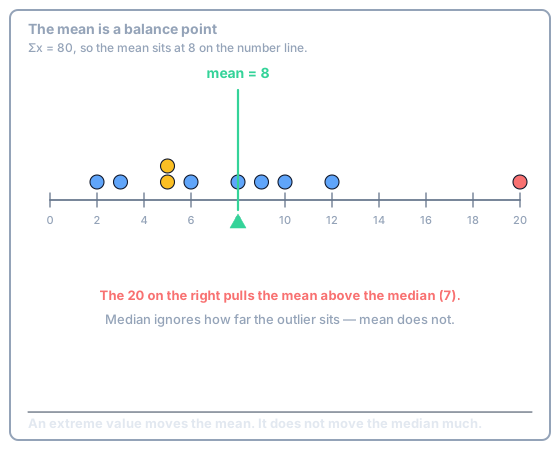
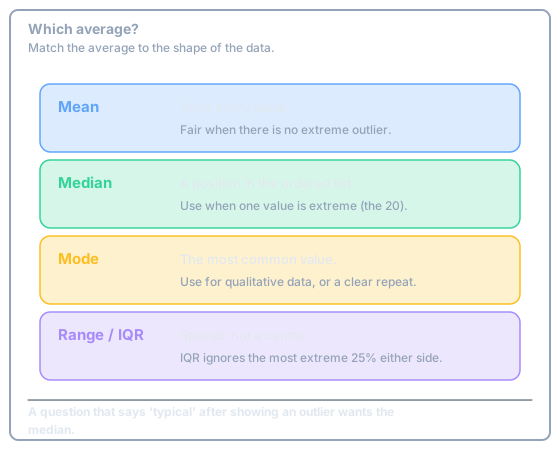
Use the mean when there is no extreme value. Use the median when one value sits far from the rest — that 20 is the reason. Use the mode for qualitative data, or when a value clearly repeats.
A full worked list
3, 5, 5, 6, 8, 9, 13. Find the mean, median, mode, range and IQR.
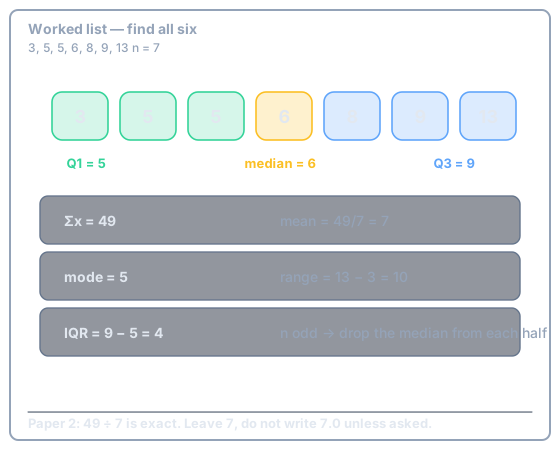
Paper 2 (non-calculator)
\(49 \div 7 = 7\) exactly. \(80 \div 10 = 8\). Leave integers as integers.
Try this
From 2, 3, 5, 5, 6, 8, 9, 10, 12, 20 find the IQR.
Show answer
-
\(Q_1 = 5\), \(Q_3 = 10\).
\[ 10 - 5 = 5 \]
Exam Traps
- The mean of an even list’s two middle values is the median — do not then also include those two values as a third “middle”.
0/10