Cambridge IGCSE Mathematics — 0580 Extended
Topic 9.4: Statistics — Grouped Data
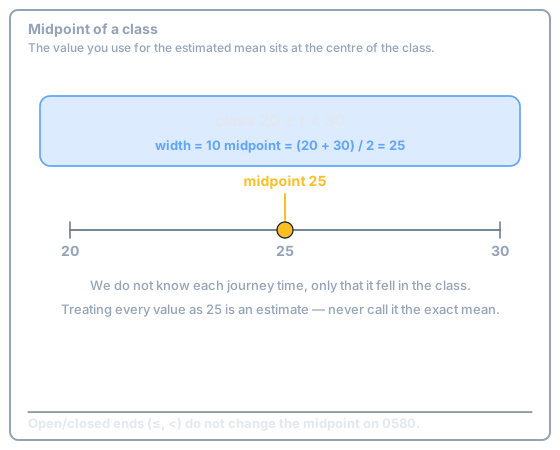
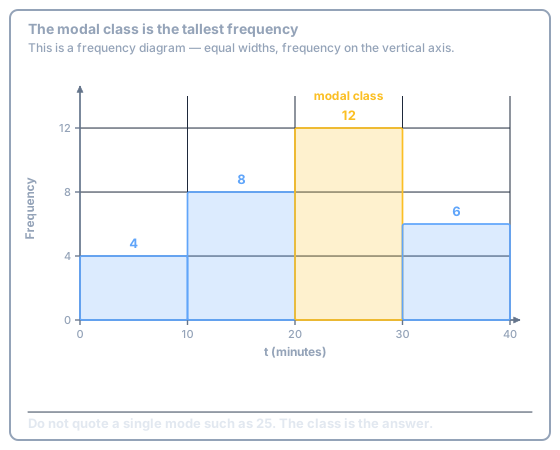
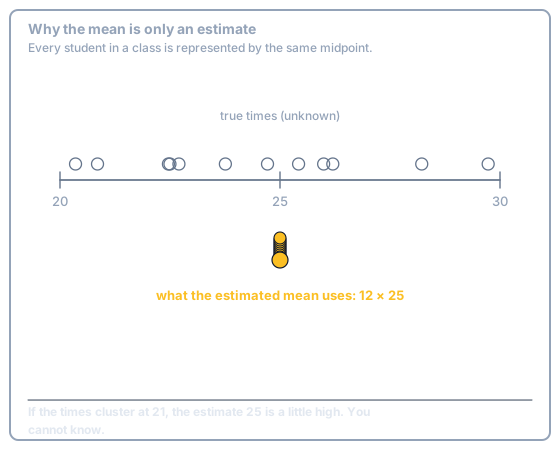
Once data are in classes you no longer know each value. The estimated mean treats every observation as the class midpoint. The modal class is the class with the largest frequency — not a single number.
Midpoints
Midpoint \(= \) (lower end \(+\) upper end) \(/ 2\). For \(20 \le t < 30\) that is 25. Open or closed ends do not change the midpoint on 0580.
Estimated mean
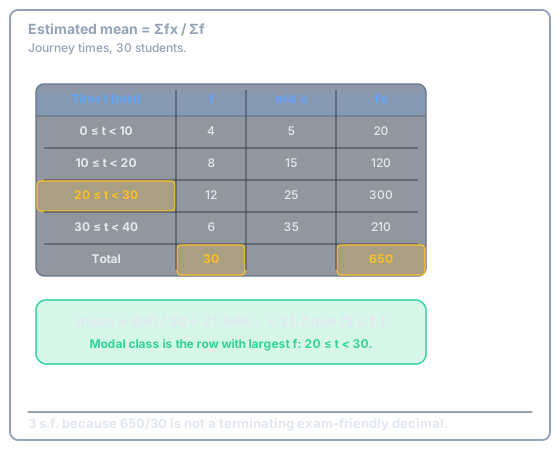
Add a midpoint column \(x\) and a product column \(fx\). Then
\[ \text{estimated mean} = \dfrac{\Sigma fx}{\Sigma f} \]
Method
- Write midpoints.
- Multiply \(f \times x\) in each row.
- Add the \(f\) column and the \(fx\) column.
- Divide. Round only at the end (3 s.f. unless the question says otherwise).
Estimate the mean journey time.
Modal class
The class with the largest \(f\). Quote the interval, not its midpoint.
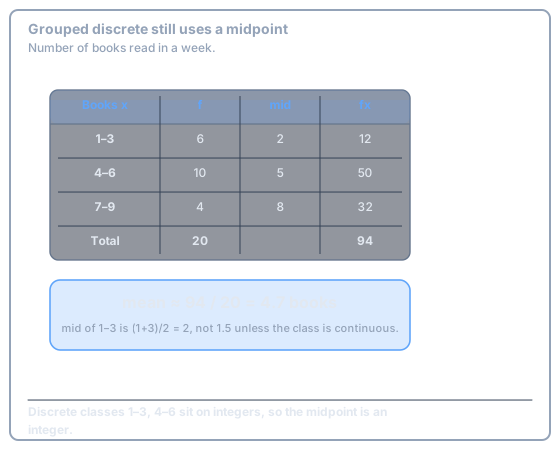
Grouped discrete
Classes such as 1–3, 4–6 sit on integers. The midpoint of 1–3 is \((1+3)/2 = 2\).
Paper 2 (non-calculator)
\(650 \div 30 = 21.\overline{6}\). The paper will accept \(21.7\) (3 s.f.) or \(65/3\) if it asks for a fraction.
Try this
In the journey table, which class is the modal class?
Show answer
-
Largest frequency is 12.
\[ 20 \le t < 30 \]
Exam Traps
- Never call \(21.7\) “the mean”. It is an estimate of the mean — the papers award the word.
0/10