Cambridge IGCSE Physics · 0625
Chapter 1: Motion, forces and energy — Part 1
Topic 1.1 · Physical quantities and measurement techniques
Measuring length, volume and time
Physical quantities are measured with the correct instrument, then recorded with a unit. You need to describe these techniques:
- Length
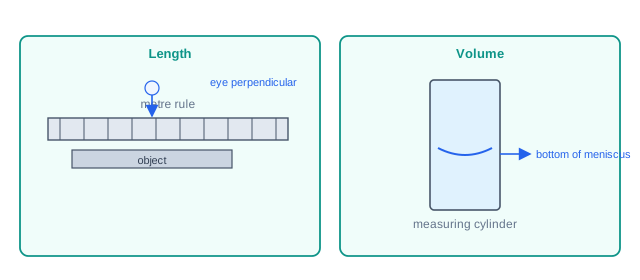
- Use a ruler or metre rule. Place the zero of the scale at one end of the object. Keep your eye perpendicular to the scale to avoid a parallax error.
- Volume of a liquid
- Use a measuring cylinder. Read the volume at the bottom of the meniscus with the eye level with the liquid surface.
- Time intervals
- Use a clock or digital timer (stopwatch) for events such as a trolley run, a falling object, or a pendulum swing.
Averages for small distances and short times
A single small length or a single short interval is hard to measure accurately. Measure multiples, then divide.
- Small distance
- Measure several identical objects placed end to end (or several gaps) and divide the total length by the number of objects.
- Short time / pendulum
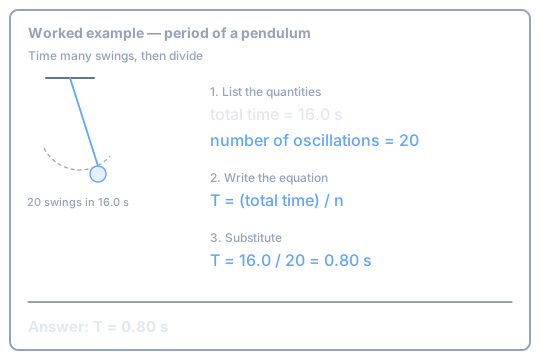
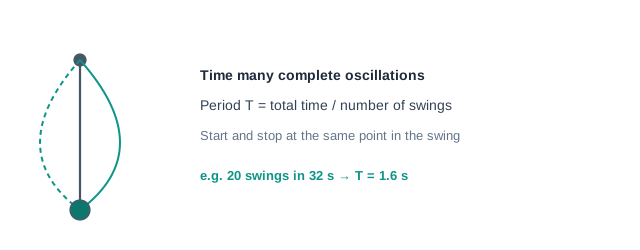
- Time a large number of complete oscillations of a pendulum. Period T = (total time) / (number of oscillations). Start and stop the timer at the same point in the swing.
A student times 20 complete oscillations of a pendulum. The total time is 16.0 s. Calculate the period T.
Scalars and vectors
A scalar has magnitude (size) only. A vector has magnitude and direction.
| Scalars | Vectors |
|---|---|
| distance, speed, time, mass, energy, temperature | force, weight, velocity, acceleration, momentum, electric field strength, gravitational field strength |
Learn this list. Mixing speed with velocity, or mass with weight, is a common Paper 2 / Paper 4 error.
Resultant of two perpendicular vectors
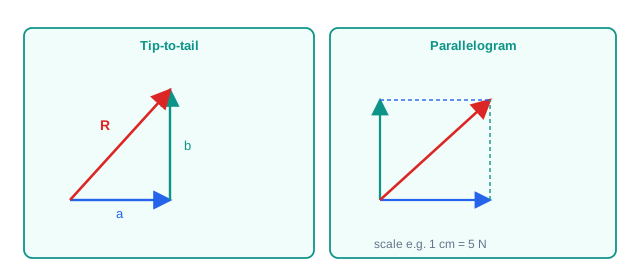
If two forces or two velocities act at right angles, their resultant can be found by calculation or by a scale drawing.
- Calculation
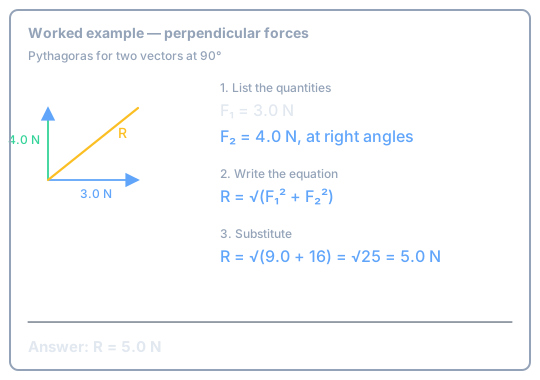
- Use Pythagoras: resultant magnitude R = √(a2 + b2). The direction is the angle whose tan is (opposite component) / (adjacent component).
- Graphically
- Draw the two vectors tip-to-tail (or as a parallelogram). The resultant is the diagonal from the start of the first to the end of the second. Use a stated scale (e.g. 1 cm = 5 N).
This applies to forces or velocities only, and only when they are at right angles.
Two forces of 3.0 N and 4.0 N act at right angles. Calculate the magnitude of the resultant.
0/10