Cambridge IGCSE Physics · 0625
Chapter 1: Motion, forces and energy — Part 3
Topic 1.3 · Mass and weight
Mass
Mass is a measure of the quantity of matter in an object at rest relative to the observer.
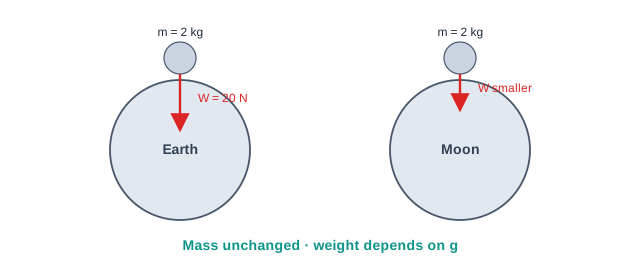
Mass is a scalar. Its SI unit is the kilogram (kg). Mass does not change if the object is taken to the Moon.
Weight and gravitational field strength
Weight is a gravitational force on an object that has mass. Weight is a vector (it acts towards the centre of the planet). Unit: newton (N).
Gravitational field strength g is force per unit mass:
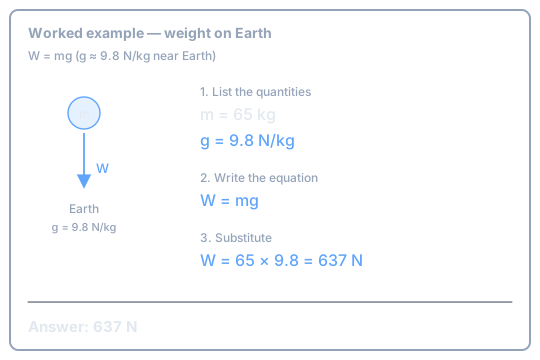
g = W / m so W = mg.
This g is equivalent to the acceleration of free fall (about 9.8 N/kg or 9.8 m/s2 near Earth).
A student has mass 65 kg. Calculate her weight on Earth. Take g = 9.8 N/kg.
Exam Traps
- Do not write weight in kilograms — mass is in kg; weight is a force in N. W = mg, not W = m.
Weight as the effect of a gravitational field
A gravitational field is a region where a mass experiences a force. Weight is the effect of that field on a mass.
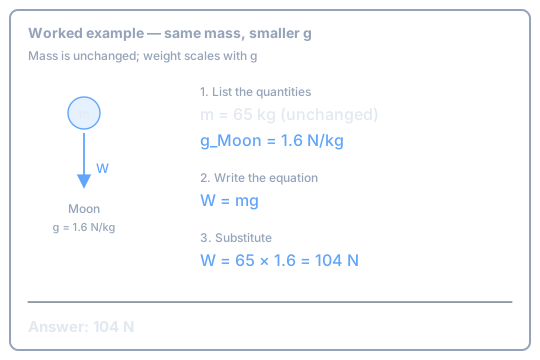
On the Moon, mass is the same but g is smaller, so weight is smaller.
The same student (mass 65 kg) stands on the Moon where g = 1.6 N/kg. Calculate her weight on the Moon.
Weights (and masses) may be compared using a balance.
0/10