Ad Banner Placeholder
Cambridge IGCSE Physics · 0625
Chapter 1: Motion, forces and energy — Part 4
Topic 1.4 · Density
Density
Density is mass per unit volume.
ρ = m / V Unit: kg/m3 or g/cm3 (1 g/cm3 = 1000 kg/m3).
An object floats in a fluid if its average density is less than the density of the fluid. It sinks if its density is greater.
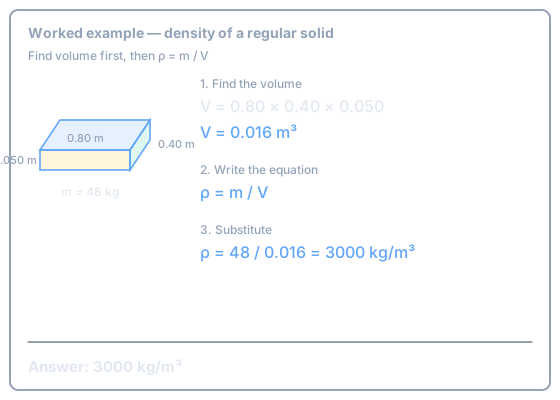
A metal block has mass 48 kg and measures 0.80 m × 0.40 m × 0.050 m. Calculate its density.
Measuring density
- Liquid
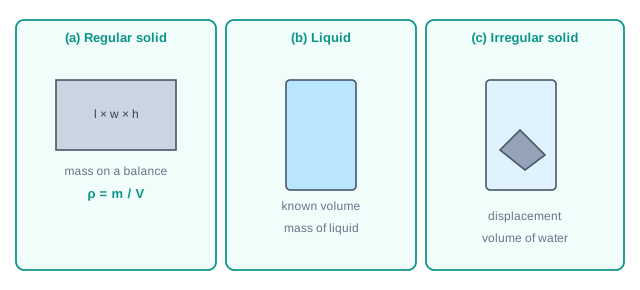
- Find the mass of a known volume using a measuring cylinder and a balance. ρ = m / V.
- Regular solid
- Mass on a balance. Volume from length × width × height (or the formula for that shape).
- Irregular solid that sinks
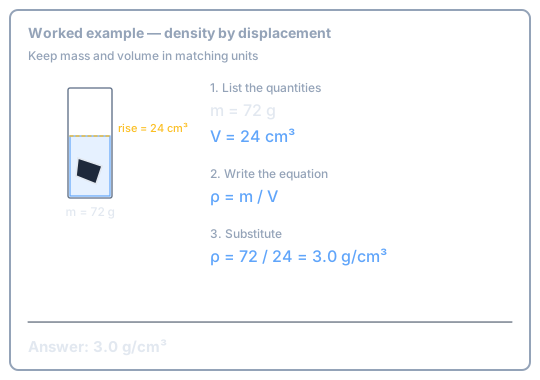
- Mass on a balance. Volume by displacement: note the water level, immerse the solid, the rise in level is the volume.
An irregular stone has mass 72 g. Lowered into a measuring cylinder, it displaces 24 cm3 of water. Calculate the density of the stone.
Immiscible liquids
If two liquids do not mix, the less dense liquid floats on the denser liquid. Compare the given density values.
0/10
Ad Banner Placeholder