Cambridge IGCSE Physics · 0625
Chapter 1: Motion, forces and energy — Part 5
Topic 1.5.1 · Effects of forces
Changing size and shape
Forces may change the size and shape of an object (stretching, compressing, bending).
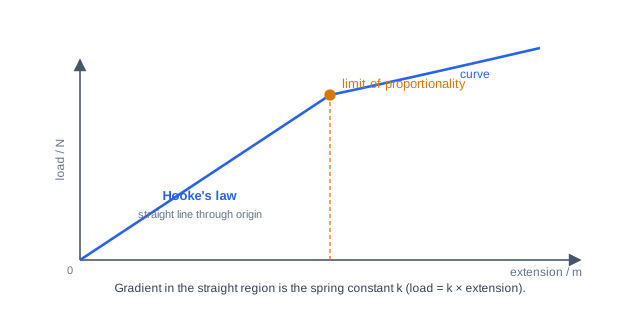
For an elastic solid, plot load against extension. Typical method: hang a spring, add masses, measure extension = new length − original length, and plot.
Spring constant and limit of proportionality
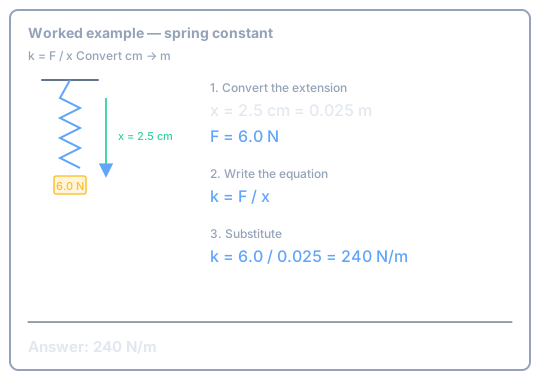
The spring constant k is force per unit extension: k = F / x. Unit: N/m.
The limit of proportionality is the point on a load–extension graph up to which the line is straight (extension ∝ load). Identify it as the end of the linear section. An understanding of elastic limit is not required.
A spring extends by 2.5 cm when a load of 6.0 N is applied, below the limit of proportionality. Calculate the spring constant k.
Resultant force and motion in a straight line
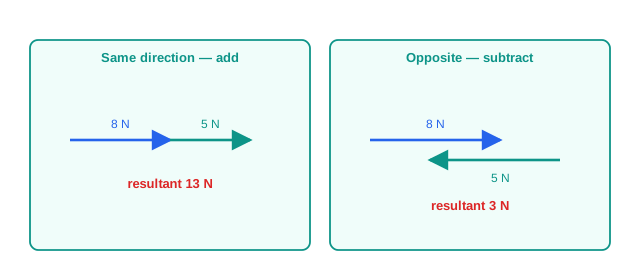
The resultant of forces on the same straight line is found by adding forces in the same direction and subtracting forces in opposite directions.
An object remains at rest or continues in a straight line at constant speed unless a resultant force acts.
A resultant force may change velocity by changing speed or direction (or both).
F = ma
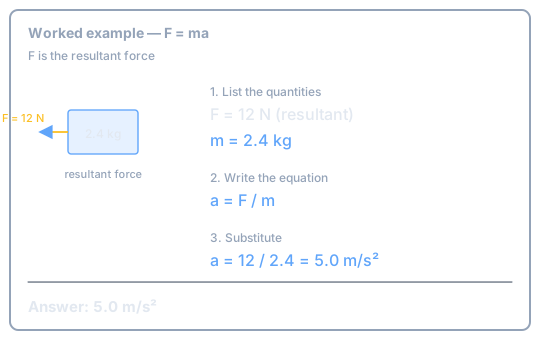
Recall and use F = ma. Force and acceleration are in the same direction.
F here is the resultant force, not ‘any force shown on the diagram’.
The resultant force on a 2.4 kg trolley is 12 N. Calculate its acceleration.
Circular motion
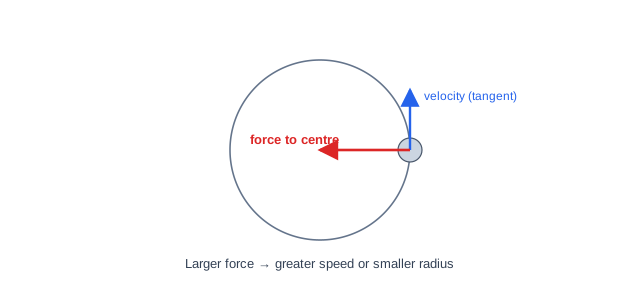
Motion in a circular path needs a force perpendicular to the motion (towards the centre). Qualitatively, with the other two quantities held constant:
- speed increases if force increases (mass and radius constant)
- radius decreases if force increases (mass and speed constant)
- a larger mass needs a larger force to keep speed and radius constant
The equation F = mv2/r is not required.
Friction and drag
Solid friction is the force between two surfaces that may impede motion and produce heating.
Drag is friction that acts on an object moving through a liquid or a gas (air resistance). Drag always opposes the motion through the fluid.
0/10