Cambridge IGCSE Physics · 0625
Chapter 1: Motion, forces and energy — Part 6
Topic 1.5.2 · Turning effect of forces
Moment of a force
The moment of a force is a measure of its turning effect (opening a door, tightening a nut with a spanner, a see-saw).
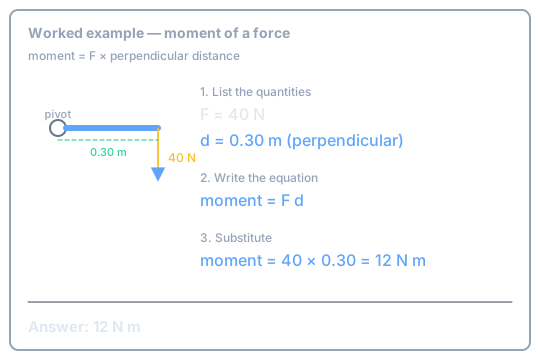
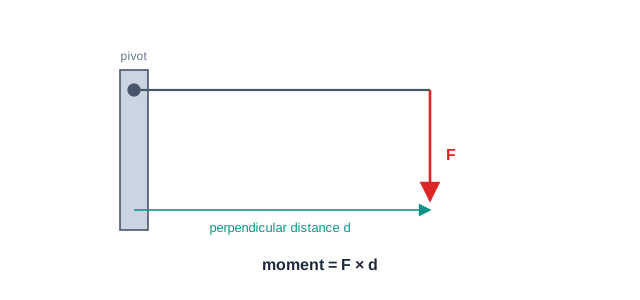
moment = force × perpendicular distance from the pivot.
Unit: N m (newton metre). Use the perpendicular distance from the line of action of the force to the pivot — not the slanted length along a beam if the force is at an angle.
A force of 40 N is applied at right angles to a spanner, 0.30 m from the centre of a nut. Calculate the moment of the force about the nut.
Principle of moments and equilibrium
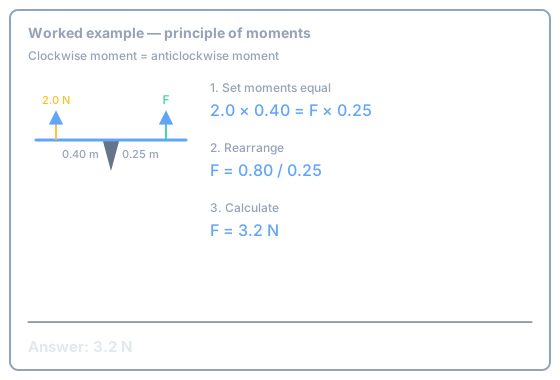
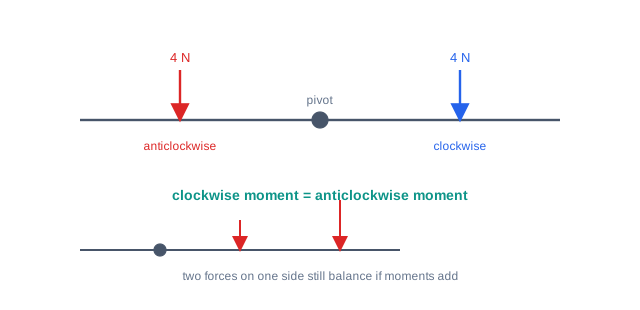
For a balanced beam with one force each side of the pivot: clockwise moment = anticlockwise moment.
When there is no resultant force and no resultant moment, an object is in equilibrium.
You must also apply the principle when there is more than one force each side of the pivot: add moments that turn the same way.
An experiment to show there is no resultant moment in equilibrium: a balanced metre rule with known masses; calculate clockwise and anticlockwise moments and show they are equal (within experimental error).
A light beam is balanced at its centre. A 2.0 N weight hangs 0.40 m to the left of the pivot. What force F, 0.25 m to the right of the pivot, keeps the beam in equilibrium?
0/10