Cambridge IGCSE Physics · 0625
Chapter 1: Motion, forces and energy — Part 9
Topic 1.7.1 · Energy
Energy stores
Energy may be stored as: kinetic, gravitational potential, chemical, elastic (strain), nuclear, electrostatic, and internal (thermal).
Energy is transferred between stores by: forces (mechanical work), electric currents (electrical work), heating, and waves (electromagnetic, sound and other waves).
Conservation of energy
Energy cannot be created or destroyed. The total energy of a closed system is constant. Apply this to simple examples and to simple flow diagrams (arrows between stores).
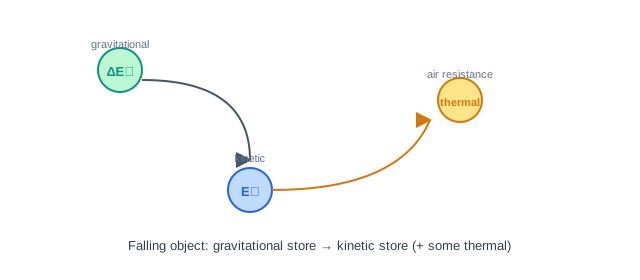
Kinetic and gravitational potential energy
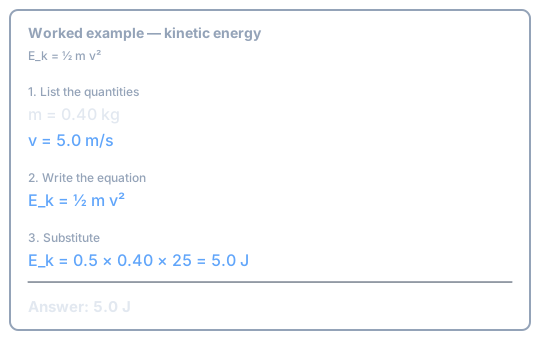
Ek = ½ mv2
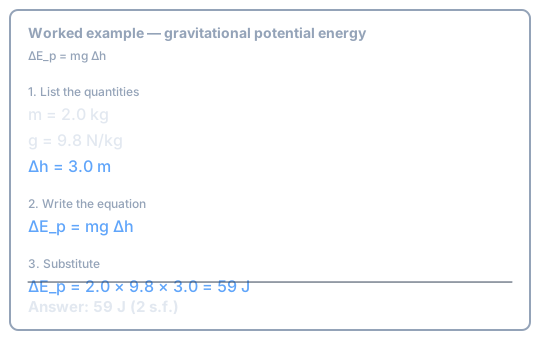
Change in gravitational potential energy ΔEp = mgΔh
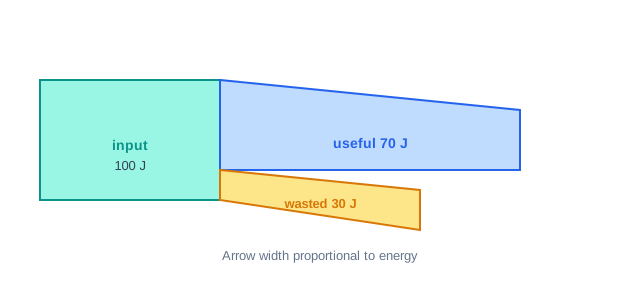
Apply conservation to multi-stage processes and interpret Sankey diagrams (arrow width ∝ energy; wasted energy shown branching off).
A 0.40 kg ball moves at 5.0 m/s. Calculate its kinetic energy.
A 2.0 kg box is lifted 3.0 m at constant speed. Take g = 9.8 N/kg. Calculate the gain in gravitational potential energy.
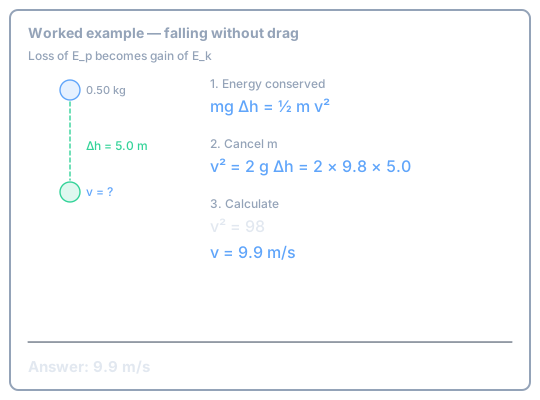
A 0.50 kg stone is dropped from rest through 5.0 m. Ignore air resistance. Take g = 9.8 N/kg. Calculate its speed just before it hits the ground.
0/10