Cambridge IGCSE Physics · 0625
Chapter 2: Thermal physics — Part 1
Topic 2.1.1–2.1.2 · States of matter and the particle model
States of matter
Solids have a fixed shape and volume. Liquids have a fixed volume but take the shape of the container. Gases fill the container and are easily compressed.
Changes of state: melting (solid to liquid), freezing (liquid to solid), boiling or evaporation (liquid to gas), condensation (gas to liquid). Direct solid-gas transfers are not required.
Particle model
- Solid
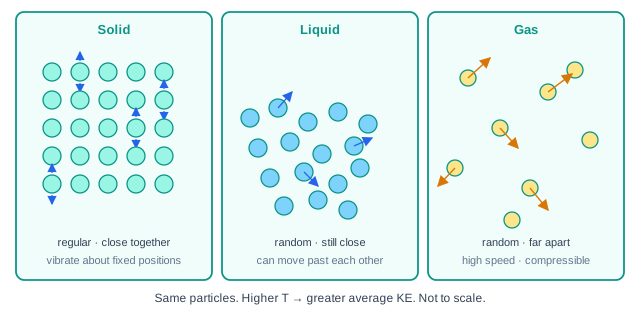
- Particles in a regular arrangement, close together, vibrating about fixed positions.
- Liquid
- Particles close together, random arrangement, able to move past each other.
- Gas
- Particles far apart, random, moving at high speed in all directions.
Higher temperature means particles move faster (more kinetic energy). There is a lowest possible temperature, absolute zero (-273 °C), where particles have least kinetic energy.
Gas pressure is due to particles colliding with a surface. More frequent or harder collisions mean higher pressure.
Forces between particles and Brownian motion
Forces and distances between particles, and their motion, affect the properties of solids, liquids and gases (for example why gases are compressible).
Gas pressure can be described as a force per unit area from particles hitting surfaces.
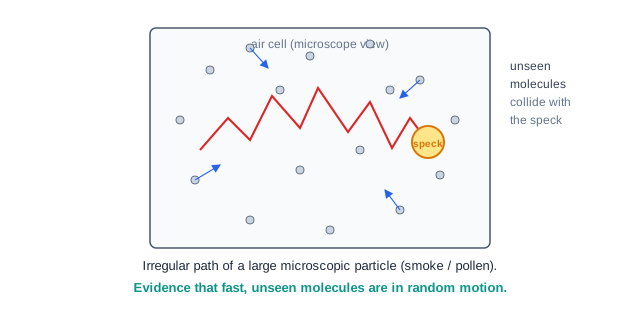
The random motion of microscopic particles in a suspension (smoke, pollen) is evidence for the kinetic model. Fast, light molecules collide with the larger specks and knock them about. Call the specks microscopic particles; call the colliding particles atoms or molecules.
0/10