Ad Banner Placeholder
Cambridge IGCSE Physics · 0625
Chapter 2: Thermal physics — Part 2
Topic 2.1.3 · Gases and the absolute scale of temperature
Pressure changes in a gas (qualitative)
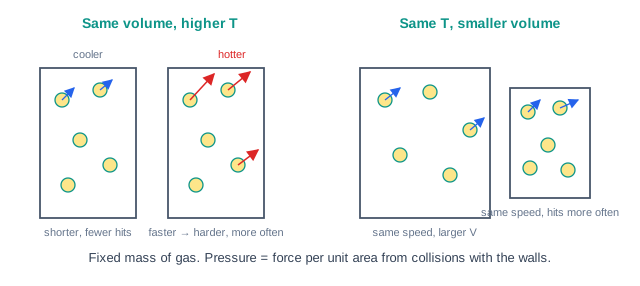
For a fixed mass of gas, in terms of particles:
- Temperature up, volume constant
- Particles move faster, so more frequent and harder collisions, so pressure rises.
- Volume down, temperature constant
- Particles hit the walls more often, so pressure rises.
Kelvin and Celsius
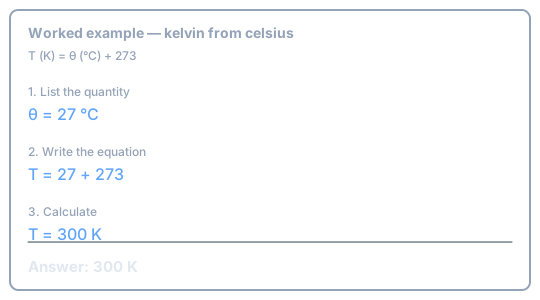
Convert with T (in K) = θ (in °C) + 273.
Examples: 0 °C = 273 K; 27 °C = 300 K; 0 K = -273 °C.
Convert 27 °C to kelvin.
pV = constant
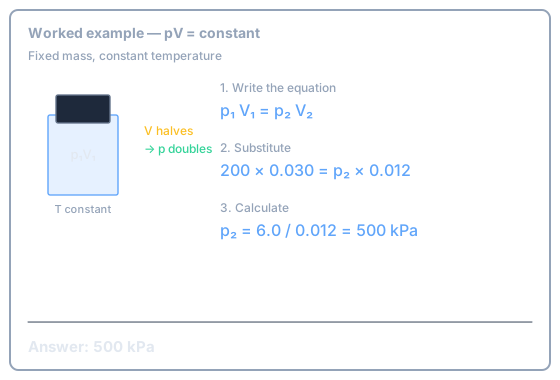
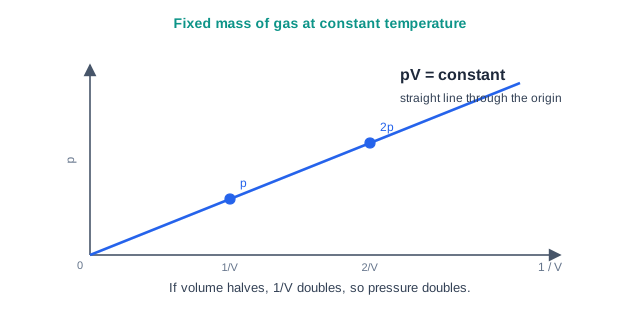
For a fixed mass of gas at constant temperature, pV = constant.
If volume halves, pressure doubles. A graph of p against 1/V is a straight line through the origin.
A fixed mass of gas at constant temperature has pressure 200 kPa and volume 0.030 m3. The volume is reduced to 0.012 m3. Calculate the new pressure.
0/10
Ad Banner Placeholder