Cambridge IGCSE Physics · 0625
Chapter 3: Waves — Part 1
Topic 3.1 · General properties of waves
What a wave transfers
Waves transfer energy without transferring matter. A cork on water bobs up and down as the wave passes; it is not carried along with the energy.
Wave motion can be shown with a rope or spring, and with water waves in a ripple tank.
Wave features
- Wavefront
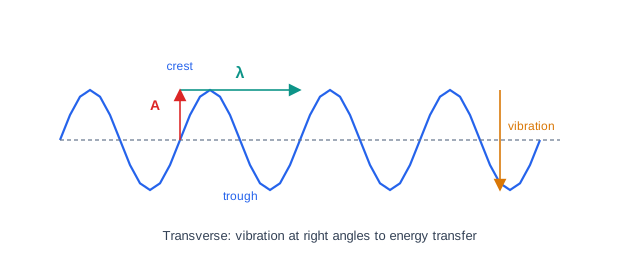
- A line joining points that are in step (for example, a line along a crest).
- Wavelength λ
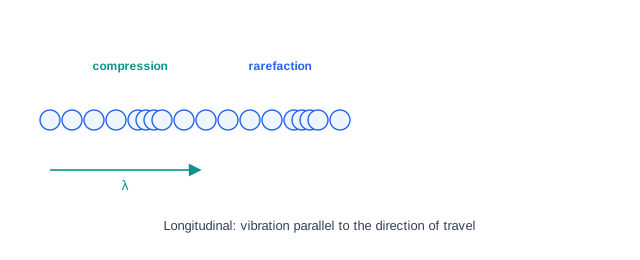
- Distance between neighbouring crests (or neighbouring compressions).
- Frequency f
- Number of waves per second. Unit: hertz (Hz).
- Amplitude
- Maximum displacement from the rest position.
- Wave speed v
- Distance travelled by a wavefront per unit time.
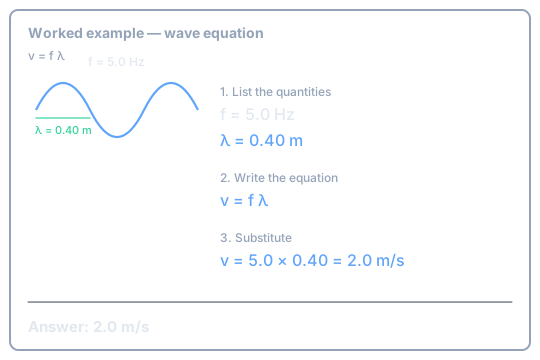
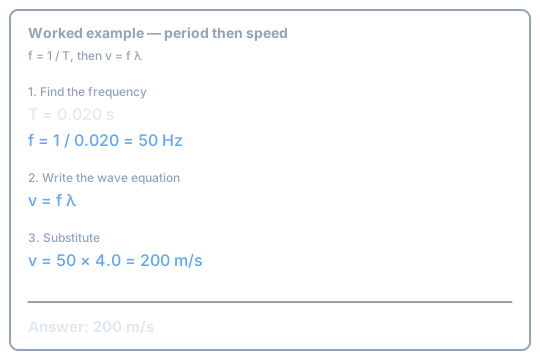
Wave equation: v = fλ
A water wave has frequency 5.0 Hz and wavelength 0.40 m. Calculate the wave speed.
A sound wave has period 0.020 s and wavelength 4.0 m. Calculate its speed.
Transverse and longitudinal
In a transverse wave, vibration is at right angles to the direction of travel. Model electromagnetic waves, water waves and seismic S-waves as transverse.
In a longitudinal wave, vibration is parallel to the direction of travel. Model sound and seismic P-waves as longitudinal.
Reflection, refraction and diffraction
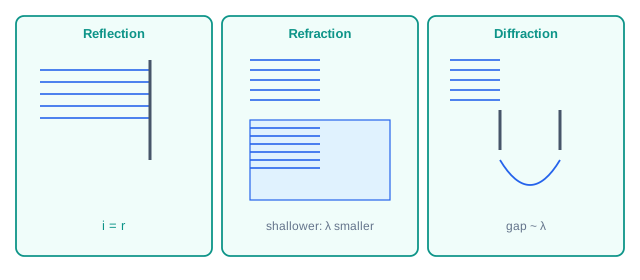
Waves can:
- reflect at a plane surface
- refract because speed changes (in a ripple tank, when depth changes)
- diffract through a narrow gap and at an edge
A ripple tank shows all three: barrier for reflection; shallow region for refraction; gap and edge for diffraction.
Diffraction through a gap is more noticeable when the gap is comparable to the wavelength. Longer wavelength diffracts more at an edge.
0/10