Ad Banner Placeholder
Cambridge IGCSE Physics · 0625
Chapter 3: Waves — Part 6
Topic 3.3 · Electromagnetic spectrum
The family of EM waves
All electromagnetic waves travel at the same high speed in a vacuum.
That speed is 3.0 × 10⁸ m/s, and it is approximately the same in air.
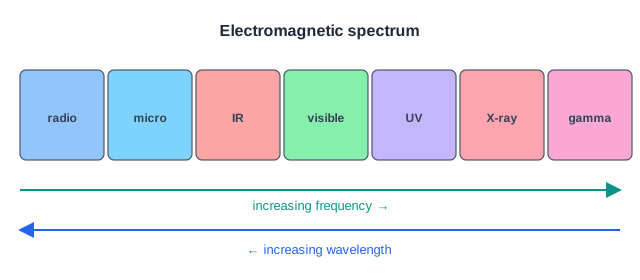
Order of increasing frequency (decreasing wavelength): radio → microwave → infrared → visible → ultraviolet → X-rays → gamma rays.
Uses and hazards
| Region | Typical uses | Harm from excessive exposure |
|---|---|---|
| Radio | Radio and TV, astronomy, RFID | — |
| Microwaves | Satellite TV, mobile phones, microwave ovens | Internal heating of body cells |
| Infrared | Grills, remote controls, intruder alarms, thermal imaging, optical fibres | Skin burns |
| Visible | Vision, photography, illumination | — |
| Ultraviolet | Security marking, fake-note detection, sterilising water | Damage to surface cells and eyes (skin cancer, eye conditions) |
| X-rays | Medical scanning, security scanners | Mutation or damage to cells |
| Gamma | Sterilising food and medical equipment; cancer detection and treatment | Mutation or damage to cells |
Satellites
Communication with artificial satellites is mainly by microwaves.
- Some satellite phones use low-orbit satellites.
- Some satellite phones and direct-broadcast satellite TV use geostationary satellites.
Communications, digital and analogue
- Mobile phones and wireless internet use microwaves because they can penetrate some walls and need only a short aerial.
- Bluetooth uses radio waves, which pass through walls but the signal is weakened.
- Optical fibres (visible light or infrared) are used for cable TV and high-speed broadband because glass is transparent to those wavelengths and they can carry high data rates.
A digital signal has a small number of discrete levels (often two). An analogue signal varies continuously. Sound can be sent either way.
Digital signalling allows a higher data rate and a longer range because the signal can be regenerated accurately (noise is less of a problem).
0/10
Ad Banner Placeholder