Cambridge IGCSE Physics · 0625
Chapter 3: Waves — Part 7
Topic 3.4 · Sound
How sound travels
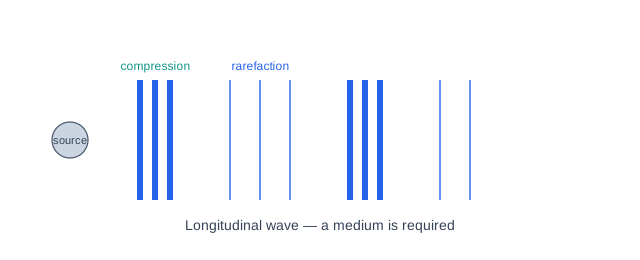
Sound is produced by vibrating sources. It is a longitudinal wave.
A medium is needed — sound does not travel in a vacuum.
Speed of sound in air is about 330–350 m/s.
The approximate range of frequencies audible to humans is 20 Hz to 20 000 Hz.
Loudness, pitch and echoes
Greater amplitude means a louder sound. Greater frequency means a higher pitch.
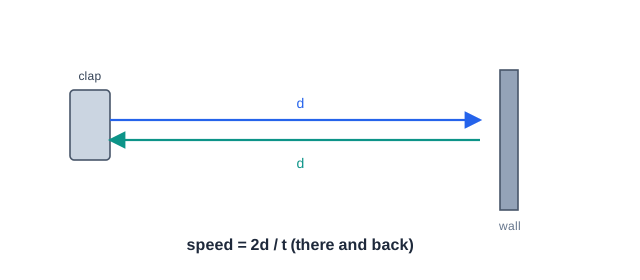
An echo is a reflection of sound.
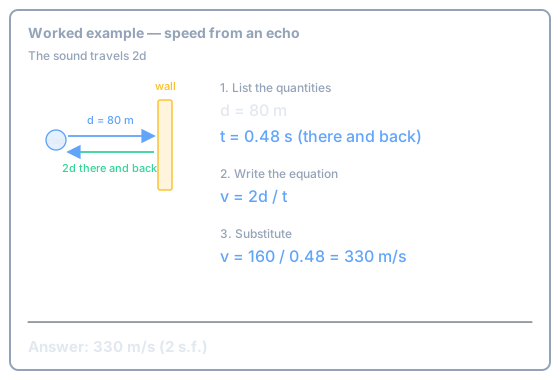
Speed in air can be found by measuring a distance and a time (for example clap-and-echo: speed = 2d / t).
A student claps 80 m from a wall. The echo returns in 0.48 s. Calculate the speed of sound in air.
Ultrasound is sound with frequency higher than 20 kHz.
Compressions, speed in materials, ultrasound uses
A compression is a region of higher pressure (particles closer). A rarefaction is a region of lower pressure (particles further apart).
In general, sound travels faster in solids than in liquids, and faster in liquids than in gases.
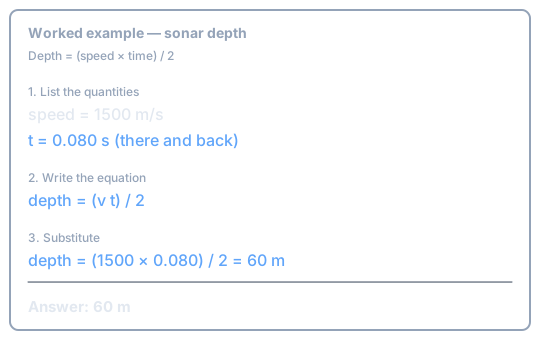
Ultrasound is used in non-destructive testing of materials, medical scanning of soft tissue, and sonar. Depth or distance = (speed × time) / 2 for a pulse that goes to a reflector and back.
A sonar pulse is sent from a boat. The echo from the sea bed returns after 0.080 s. Speed of sound in sea water = 1500 m/s. Calculate the depth of the water.
0/10