Cambridge IGCSE Physics · 0625
Chapter 4: Electricity and magnetism — Part 2
Topic 4.2.1 · Electric charge
Two types of charge
There are positive and negative charges.
Like charges repel. Opposite charges attract.
Charge is measured in coulombs (C).
Charging by friction, conductors and insulators
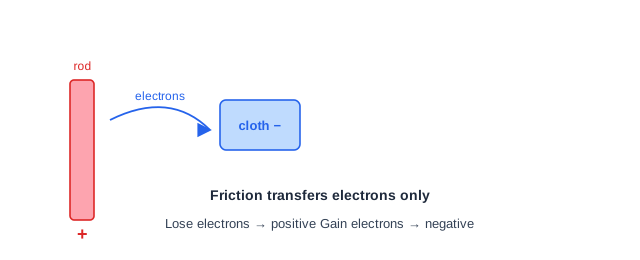
Rubbing two insulating materials transfers electrons (negative charge only). The object that gains electrons becomes negative; the object that loses electrons becomes positive. Protons do not move in this process.
Detect charge with a gold-leaf electroscope or by seeing repulsion of a charged object.
- Conductors
- Have free electrons that can move (metals, graphite). Charge flows through them.
- Insulators
- Electrons are not free to move through the material (plastic, rubber, glass). Charge stays where it is put.
A simple test: try to pass a current through the sample in a circuit with a lamp or ammeter. Conductors complete the circuit; insulators do not.
Electric fields
An electric field is a region in which an electric charge experiences a force.
The direction of the field at a point is the direction of the force on a positive charge at that point.
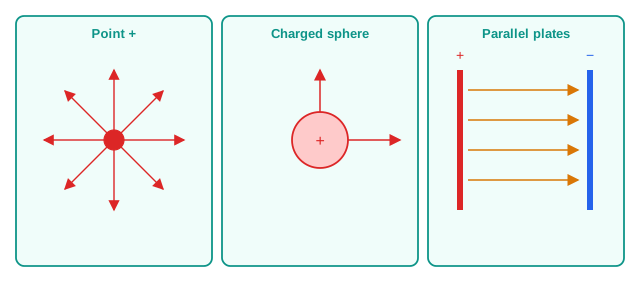
Sketch these patterns (end effects of plates are not examined):
- around a point charge — radial lines, away from + and towards −
- around a charged conducting sphere — like a point charge outside the sphere
- between two oppositely charged parallel plates — uniform field, lines from + to −, equally spaced
Exam Traps
- Charging by friction moves electrons only — a positive object is short of electrons, not full of extra protons that jumped across.
0/10