Ad Banner Placeholder
Cambridge IGCSE Physics · 0625
Chapter 4: Electricity and magnetism — Part 3
Topic 4.2.2 · Electric current
Current and charge
Electric current is related to the flow of charge.
In metals, conduction is the movement of free electrons.
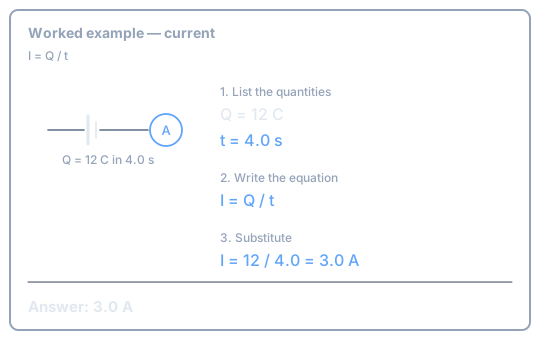
I = Q / t where I is current in amperes (A), Q is charge in coulombs (C), and t is time in seconds (s). Current is the charge passing a point per unit time.
A charge of 12 C passes a point in a wire in 4.0 s. Calculate the current.
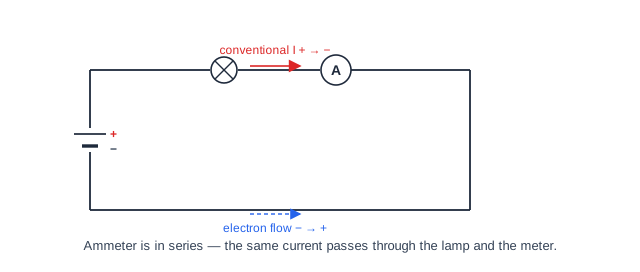
Conventional current is drawn from positive to negative. Free electrons actually flow from negative to positive.
Exam Traps
- Do not mix conventional current (positive to negative) with electron flow (negative to positive). Exam diagrams use conventional current unless they ask for electrons.
Measuring current; d.c. and a.c.
An ammeter measures current. Connect it in series. Choose a range that is not overloaded but still gives a usable reading (analogue or digital).
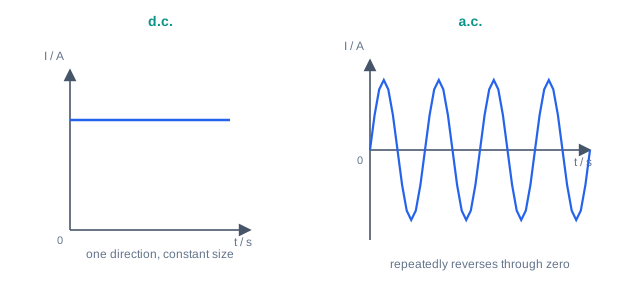
- Direct current (d.c.)
- Charge flows in one direction (cells and batteries).
- Alternating current (a.c.)
- The direction of the current repeatedly reverses (mains).
0/10
Ad Banner Placeholder