Cambridge IGCSE Physics · 0625
Chapter 4: Electricity and magnetism — Part 4
Topic 4.2.3 · Electromotive force and potential difference
e.m.f. and p.d.
Electromotive force (e.m.f.) is the electrical work done by a source in moving a unit charge around a complete circuit. It is measured in volts (V).
Potential difference (p.d.) is the work done by a unit charge passing through a component. It is also measured in volts.
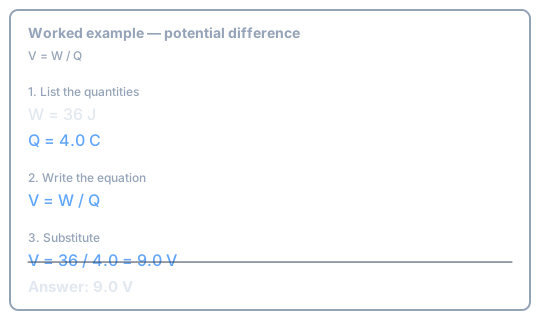
E = W / Q and V = W / Q with W in joules (J) and Q in coulombs.
1 V means 1 J of work per coulomb.
A lamp transfers 36 J of energy when 4.0 C of charge passes through it. Calculate the p.d. across the lamp.
Exam Traps
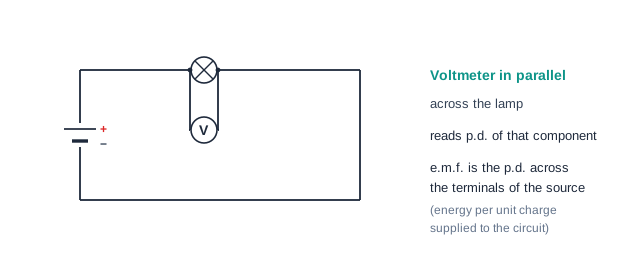
- e.m.f. belongs to the source (the whole circuit). p.d. belongs to a component or between two points. Do not call the reading across a lamp an e.m.f.
Voltmeters
A voltmeter measures p.d. Connect it in parallel with the component (or across the two points). Analogue and digital meters have different ranges — choose a range that fits the expected voltage.
0/10