Ad Banner Placeholder
Cambridge IGCSE Physics · 0625
Chapter 4: Electricity and magnetism — Part 5
Topic 4.2.4 · Resistance
Defining and measuring resistance
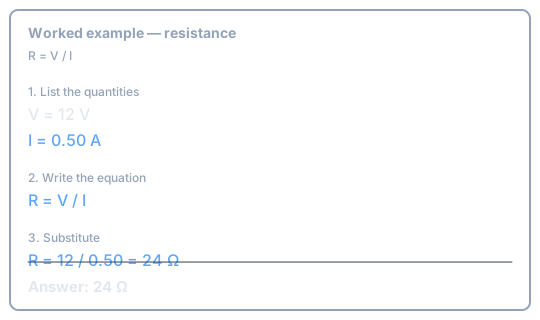
R = V / I with R in ohms (Ω), V in volts and I in amperes.
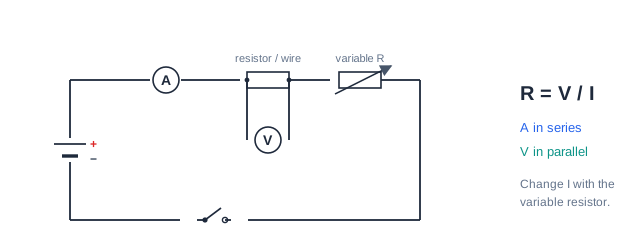
To measure resistance: connect an ammeter in series and a voltmeter in parallel with the component. Calculate R from V and I. Repeat for several values if asked.
A resistor has a p.d. of 12 V when the current is 0.50 A. Calculate its resistance.
Wires: length and area
For a metallic wire, qualitatively: longer wire → greater resistance; thicker wire (larger cross-sectional area) → smaller resistance.
Quantitatively: resistance is directly proportional to length and inversely proportional to cross-sectional area.
Current–voltage graphs
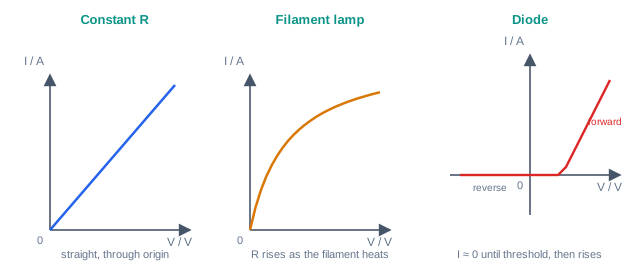
Sketch and explain I–V graphs:
- Constant resistor
- Straight line through the origin. R is constant (V proportional to I).
- Filament lamp
- Curve: current increases less quickly at higher V because the filament heats, so R increases.
- Diode
- Very small current one way (reverse); current grows when forward p.d. is large enough.
0/10
Ad Banner Placeholder