Ad Banner Placeholder
Cambridge IGCSE Physics · 0625
Chapter 4: Electricity and magnetism — Part 7
Topic 4.3.1 · Circuit diagrams and circuit components
Reading circuit diagrams
You must draw and interpret circuits using the official symbols for: cells, batteries, power supplies, generators, potential dividers, switches, fixed and variable resistors, heaters, NTC thermistors, LDRs, lamps, motors, bells, ammeters, voltmeters, magnetising coils, transformers, fuses and relays.
Extended also requires the diode and LED symbols and how they behave.
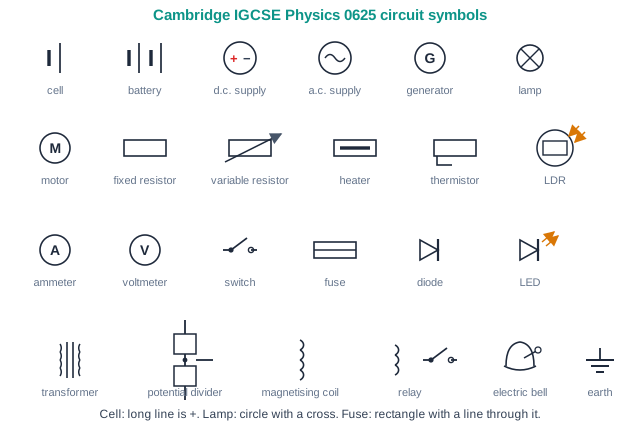
How the components behave
| Component | Behaviour in a circuit |
|---|---|
| Cell / battery / d.c. supply | Source of e.m.f.; conventional current leaves + |
| a.c. supply / generator | Source whose current repeatedly reverses |
| Switch | Open: gap, no current. Closed: complete path |
| Lamp / heater / motor / bell | Transfers electrical energy (light, thermal, kinetic, sound) |
| Ammeter / voltmeter | Ammeter in series; voltmeter in parallel |
| Fuse | Melts if current is too large, breaking the live path |
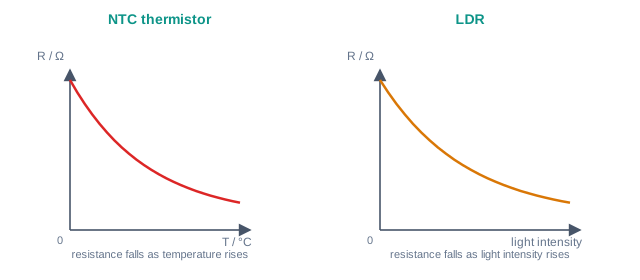
| NTC thermistor | Resistance decreases as temperature increases |
| LDR | Resistance decreases as light intensity increases |
| Variable resistor / potential divider | Lets you change current or share p.d. |
| Relay / magnetising coil | A small current magnetises a core and can close another circuit |
| Transformer | Changes a.c. voltage (needs a changing current) |
| Diode / LED | Allows current one way; LED also emits light when forward-biased |
0/10
Ad Banner Placeholder