Ad Banner Placeholder
Cambridge IGCSE Physics · 0625
Chapter 4: Electricity and magnetism — Part 11
Topic 4.5.1 · Electromagnetic induction
Inducing an e.m.f.
An e.m.f. is induced in a conductor when:
- the conductor moves across a magnetic field, or
- the magnetic field linking with the conductor changes (for example a magnet moving into a coil).
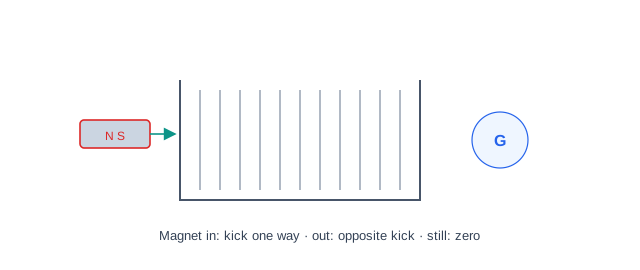
Show this with a coil, a magnet and a sensitive meter (galvanometer). A kick one way as the magnet enters, the opposite way as it leaves; no reading when everything is still.
Size and direction of the induced e.m.f.
The magnitude of the induced e.m.f. is greater if you increase:
- the speed of the motion (or the rate of change of the field)
- the magnetic field strength
- the number of turns on the coil (and, for a moving rod, the length in the field)
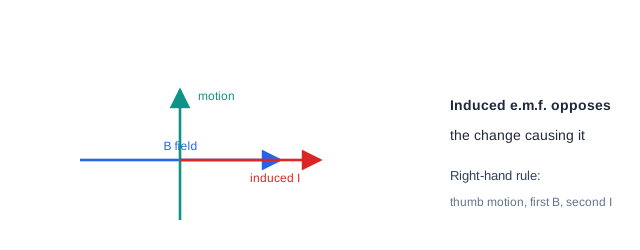
The direction of the induced e.m.f. opposes the change causing it (Lenz’s law). Use the relative directions of force (motion), field and induced current (Fleming’s right-hand rule for a moving conductor: thuMb = motion, First finger = field, seCond finger = induced current).
0/10
Ad Banner Placeholder