Ad Banner Placeholder
Cambridge IGCSE Physics · 0625
Chapter 4: Electricity and magnetism — Part 12
Topic 4.5.2 · The a.c. generator
A rotating coil (or rotating magnet)
A simple a.c. generator has a coil that rotates in a magnetic field (or a magnet that rotates next to a coil). The changing flux linkage induces an alternating e.m.f.
Slip rings turn with the coil and brushes press on them so the external circuit can take the current without the wires twisting. (A rotating magnet design may not need slip rings.)
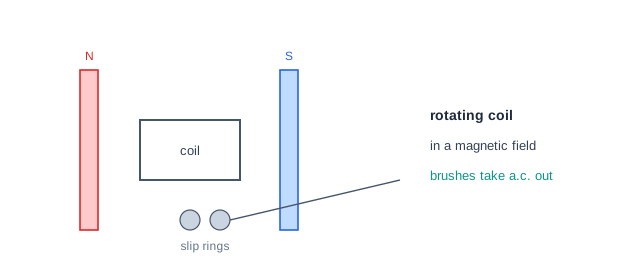
e.m.f. against time
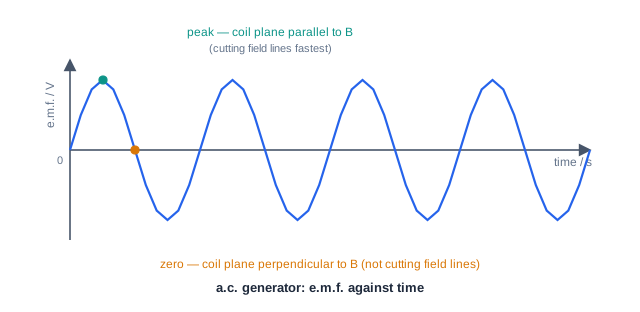
The graph of e.m.f. against time is a wave that repeatedly reverses.
- Peaks and troughs (maximum e.m.f.): the coil sides are moving straight across the field (coil plane parallel to the field) so field lines are cut at the greatest rate.
- Zeros: the coil sides are moving along the field (coil plane perpendicular to the field) so the rate of cutting field lines is zero.
Faster rotation means a larger peak e.m.f. and a higher frequency.
0/10
Ad Banner Placeholder