Cambridge IGCSE Physics · 0625
Chapter 4: Electricity and magnetism — Part 14
Topic 4.5.4 · Force on a current-carrying conductor
The motor effect
A current-carrying conductor in a magnetic field can experience a force.
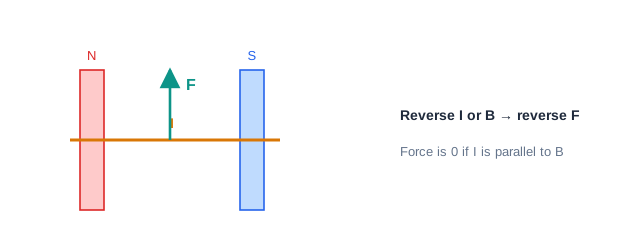
Show this with a wire between magnet poles: the wire kicks when the current is switched on. Reverse the current or reverse the field and the force reverses.
The force is greatest when the wire is at 90° to the field, and zero when the current is parallel to the field.
Directions, and beams of charge
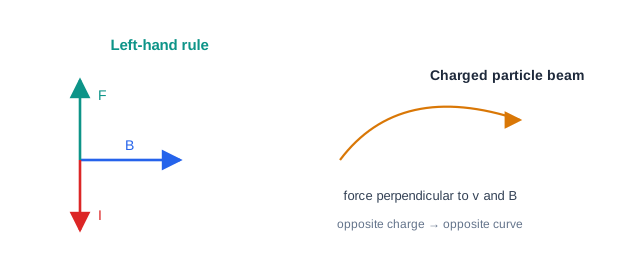
Use the relative directions of force, magnetic field and current (Fleming’s left-hand rule: thuMb = force/motion, First finger = field, seCond finger = conventional current).
Beams of charged particles in a magnetic field also experience a force (perpendicular to their velocity and to the field), so the beam curves. Reverse the particle charge and the deflection reverses.
0/10