Cambridge IGCSE Physics · 0625
Chapter 4: Electricity and magnetism — Part 16
Topic 4.5.6 · The transformer
Construction and the turns equation
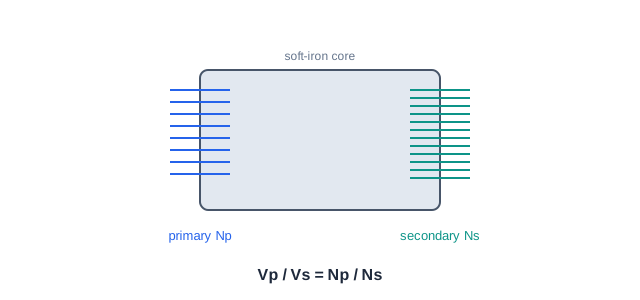
A simple transformer has a soft-iron core with a primary coil and a secondary coil. It is used to change a.c. voltages.
A step-up transformer has more secondary turns than primary turns (Vs > Vp). A step-down transformer has fewer secondary turns.
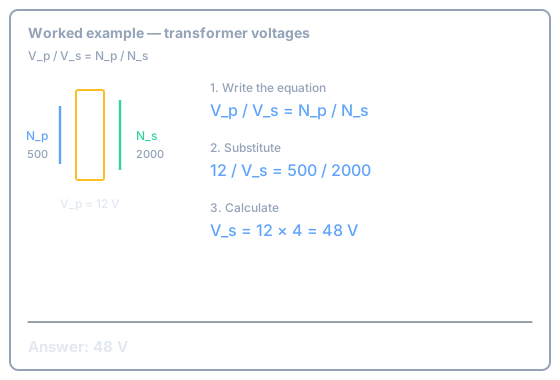
Vp / Vs = Np / Ns
An alternating current in the primary produces a changing magnetic field in the core, which induces an e.m.f. in the secondary.
A transformer has 500 primary turns and 2000 secondary turns. The primary p.d. is 12 V. Calculate the secondary p.d.
Transmission and efficiency
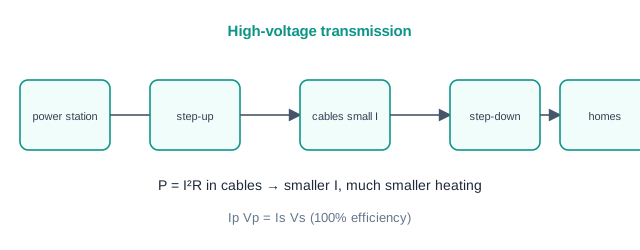
Transformers are used in high-voltage transmission of electricity. High voltage means a smaller current for the same power, so heating losses in the cables are smaller.
Advantages of high-voltage transmission: lower current, thinner (or cheaper) cables possible, less energy wasted as thermal energy in the cables.
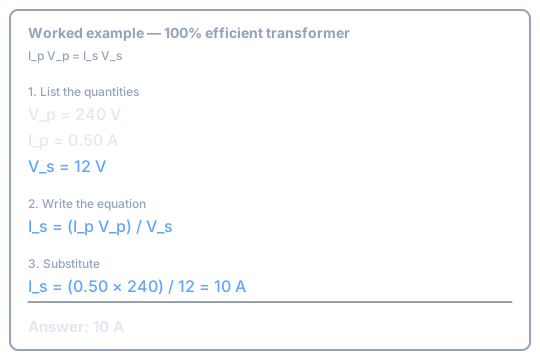
For 100% efficiency: IpVp = IsVs
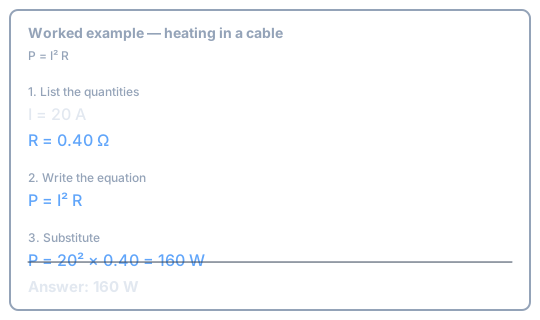
Power loss in a cable: P = I2R. Larger I means much larger heating for the same cable resistance.
A 100% efficient transformer has Vp = 240 V, Ip = 0.50 A and Vs = 12 V. Calculate the secondary current.
A transmission cable has resistance 0.40 Ω and carries 20 A. Calculate the power lost as heat in the cable.
Exam Traps
- A transformer needs a changing current (a.c., or a changing d.c.). A steady d.c. primary current does not induce a secondary e.m.f.
0/10