Ad Banner Placeholder

Cambridge IGCSE Physics · 0625

Chapter 5: Nuclear physics — Part 1

Topic 5.1.1 · The atom

The nuclear atom and ions

An atom has a positively charged nucleus with negatively charged electrons in orbit around it.

Atoms form positive ions by losing electrons and negative ions by gaining electrons.
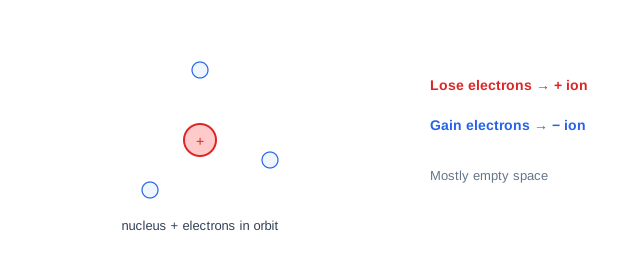
Nuclear atom: a small positive nucleus with electrons in orbit around it, and notes on forming a positive ion (losing electrons) or a negative ion (gaining electrons).
Diagram 1: Nuclear atom: a small positive nucleus with electrons in orbit around it, and notes on forming a positive ion (losing electrons) or a negative ion (gaining electrons).

Alpha-particle scattering

A beam of alpha (α) particles fired at a thin metal sheet (gold foil) supports the nuclear model:

  • Most α particles go straight through — the atom is mostly empty space.
  • Some are deflected through large angles — the nucleus is positively charged (like charges repel).
  • A very few rebound — the nucleus is very small and contains most of the mass of the atom.
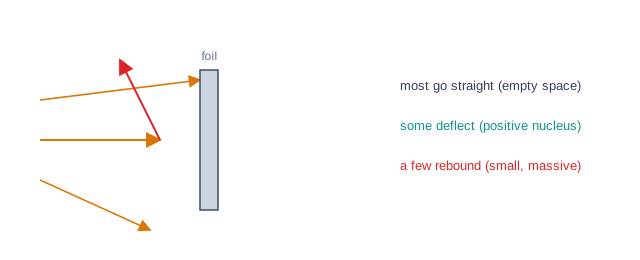
Alpha-particle scattering: most particles pass straight through a thin metal foil, some deflect, a very few rebound, supporting a tiny, massive, positive nucleus and mostly empty space.
Diagram 2: Alpha-particle scattering: most particles pass straight through a thin metal foil, some deflect, a very few rebound, supporting a tiny, massive, positive nucleus and mostly empty space.

0/10

Ad Banner Placeholder