Cambridge IGCSE Physics · 0625
Chapter 5: Nuclear physics — Part 2
Topic 5.1.2 · The nucleus
Protons, neutrons and nuclide notation
The nucleus contains protons and neutrons.
| Particle | Relative charge |
|---|---|
| Proton | +1 |
| Neutron | 0 |
| Electron | −1 |
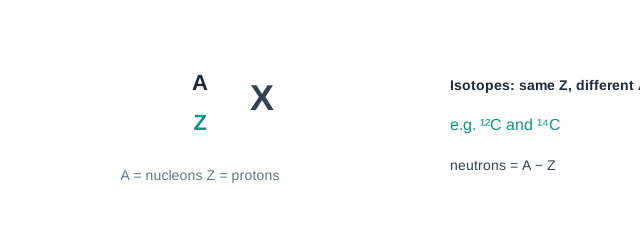
Proton number (atomic number) Z is the number of protons. Nucleon number (mass number) A is the number of protons plus neutrons.
Number of neutrons = A − Z.
Nuclide notation: AZX .
The relative charge of a nucleus is equal to Z (in units of the proton charge). The relative mass of a nucleus is equal to A (nucleon units).
Isotopes, fission and fusion
Isotopes are nuclei of the same element (same Z) with different A (different numbers of neutrons). An element can have more than one isotope.
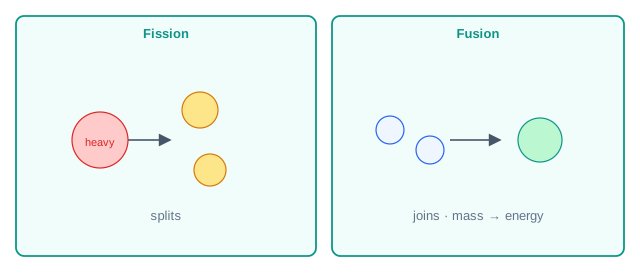
Nuclear fission is the splitting of a nucleus. Nuclear fusion is the joining of nuclei. Both can be written as a nuclide equation. A small decrease in mass is released as energy (no numerical mass–energy values are required).
0/10