Ad Banner Placeholder
Cambridge IGCSE Physics · 0625
Chapter 5: Nuclear physics — Part 4
Topic 5.2.2 · The three types of nuclear emission
Nature, ionising and penetrating
Emission from a nucleus is spontaneous and random in direction.
β means β− (an electron). β+ is not included.
| Nature | Ionising effect | Penetration | |
|---|---|---|---|
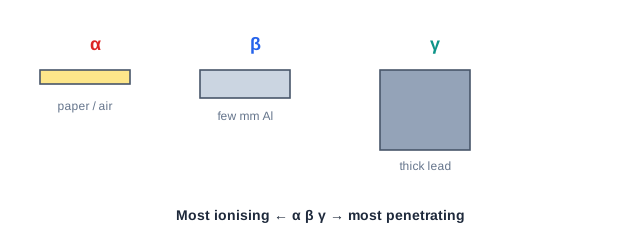
| α | helium nucleus (42He), charge +2 | strongest | stopped by paper / a few cm of air |
| β | fast electron, charge −1 | moderate | stopped by a few mm of aluminium |
| γ | EM wave, uncharged | weakest | reduced by thick lead / concrete |
α ionises strongly because it has a large charge and (typically) high kinetic energy transferred over a short path. γ has no charge and is the most penetrating.
Exam Traps
- Stronger ionising power means weaker penetration — do not say alpha is the most penetrating because it is the most ionising.
Deflection in fields
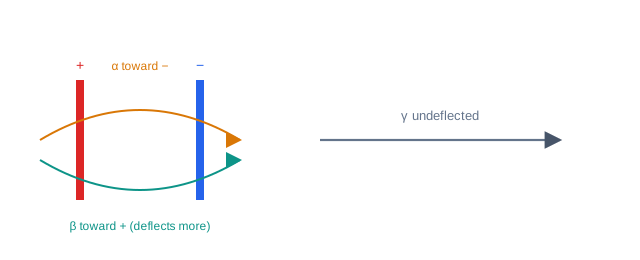
α and β particles are deflected by electric and magnetic fields (opposite ways because their charges have opposite signs). β is deflected more than α (much smaller mass). γ is not deflected.
0/10
Ad Banner Placeholder