Ad Banner Placeholder
Cambridge IGCSE Physics · 0625
Chapter 5: Nuclear physics — Part 5
Topic 5.2.3 · Radioactive decay
What decay does to the nucleus
Radioactive decay is a change in an unstable nucleus. It can emit α, β and/or γ. The changes are spontaneous and random.
During α-decay or β-decay the nucleus changes to that of a different element.
Isotopes may be radioactive because of an excess of neutrons and/or because the nucleus is too heavy.
Emission increases stability and can reduce the number of excess neutrons. In β-emission:
neutron → proton + electron
Decay equations
- α-decay
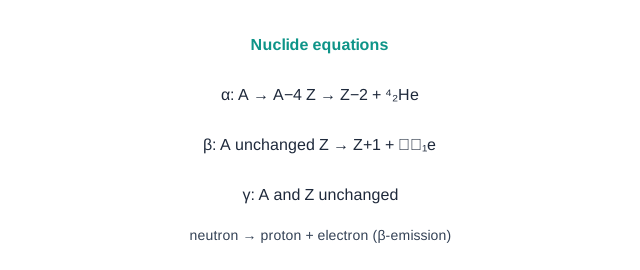
- A decreases by 4, Z decreases by 2. A helium nucleus leaves.
- β-decay
- A unchanged, Z increases by 1 (a neutron becomes a proton; an electron is emitted).
- γ-emission
- A and Z unchanged. The nucleus loses energy as an EM wave.
Balance nucleon number and proton number on both sides of the nuclide equation.
0/10
Ad Banner Placeholder