Cambridge IGCSE Physics · 0625
Chapter 5: Nuclear physics — Part 6
Topic 5.2.4 · Half-life
Definition and calculations
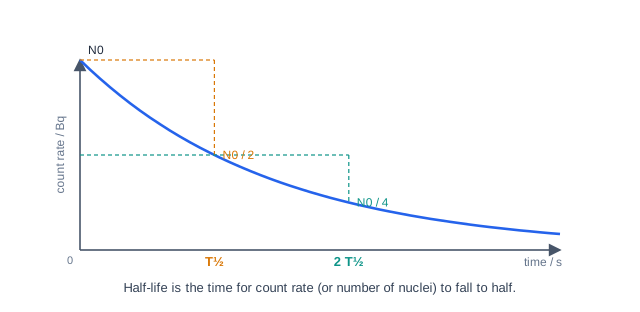
The half-life of an isotope is the time taken for half the nuclei of that isotope in any sample to decay.
After one half-life, count rate (from that isotope) is half; after two half-lives, a quarter; after three, one eighth.
Read half-life from a table or from a decay curve. Some curves have not had background subtracted — still use the graph as given when the question says so. Simple calculations in this topic do not include background radiation unless you are told to correct.
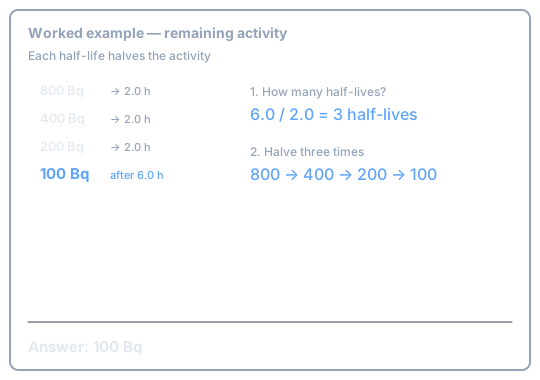
A sample has activity 800 Bq. The half-life is 2.0 h. Calculate the activity after 6.0 h.
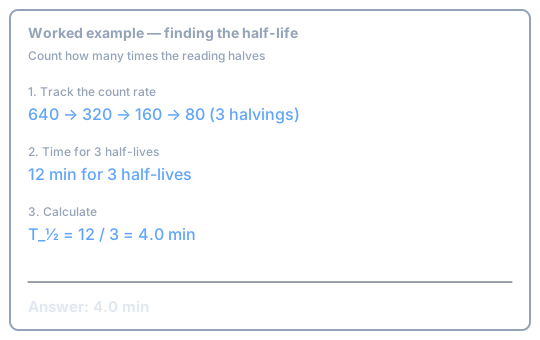
A count rate falls from 640 counts/min to 80 counts/min in 12 minutes. Calculate the half-life.
Exam Traps
- Half-life is not the time for the sample to decay completely, and not half the time to reach zero. It is the time for half the remaining nuclei of that isotope to decay.
Choosing an isotope for a use
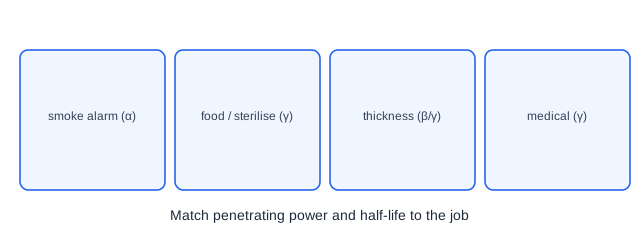
The type of radiation and the half-life together decide the use:
- Smoke (fire) alarms — typically a long-lived α source: α ionises air in the chamber; smoke changes the current. α is stopped easily, so it is not a penetrating hazard outside the unit.
- Irradiating food to kill bacteria — penetrating radiation (often γ) with a half-life suited to the industrial source.
- Sterilising equipment — γ (penetrating) to kill microbes.
- Thickness control — choose radiation that is partly absorbed by the sheet (β is common for paper/aluminium; γ for thicker metal). Detector reading changes if thickness changes.
- Diagnosis and treatment of cancer — γ (penetrating, can be detected outside the body or used to target tumours); half-life long enough to be useful, short enough not to stay active in the patient for years.
0/10