Cambridge IGCSE Physics · 0625
Chapter 6: Space physics — Part 2
Topic 6.1.2 · The Solar System
What is in the Solar System
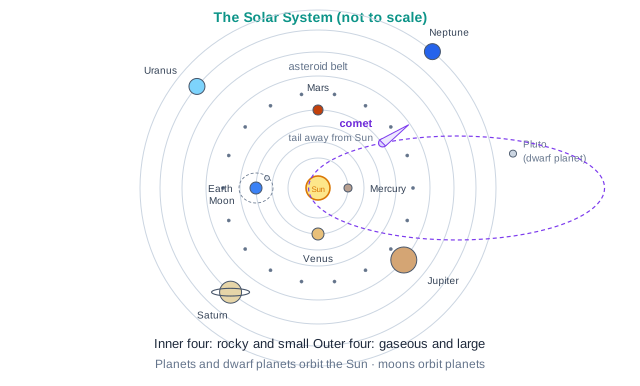
The Solar System contains:
- one star, the Sun
- the eight planets, in order from the Sun: Mercury, Venus, Earth, Mars, Jupiter, Saturn, Uranus, Neptune
- minor planets that orbit the Sun, including dwarf planets such as Pluto and asteroids in the asteroid belt
- moons that orbit planets
- smaller bodies including comets and other natural satellites
Rocky inner planets, gaseous outer planets
Compared with each other, the four planets nearest the Sun are rocky and small; the four furthest are gaseous and large.
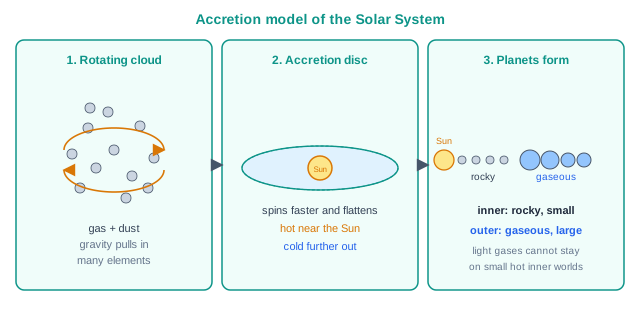
An accretion model of formation: gravity pulls together material from an interstellar cloud of gas and dust (many elements present). The cloud rotates and forms an accretion disc. Inner regions are too warm for light gases to remain as large atmospheres on small bodies; outer regions allow large gaseous planets to grow.
Orbits, gravity and light-travel time
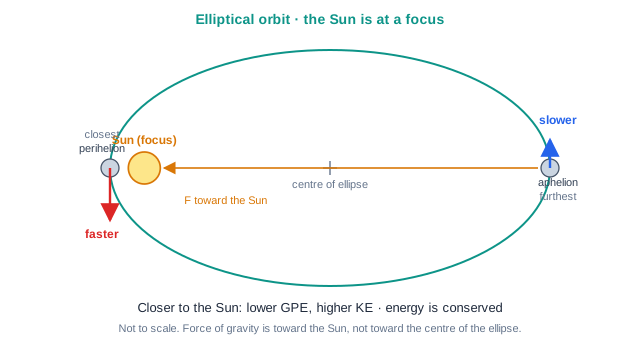
Planets, minor planets and comets have elliptical orbits. The Sun is not at the centre of the ellipse, except when the orbit is approximately circular.
Gravitational field strength at a planet’s surface is larger if the planet has larger mass. Around a planet, field strength decreases as distance from the planet increases.
The Sun contains most of the mass of the Solar System, so the planets orbit the Sun. The force that keeps an object in orbit around the Sun is the Sun’s gravitational attraction.
The Sun’s gravitational field is weaker further out, so orbital speeds of the planets decrease as distance from the Sun increases.
In an elliptical orbit the object travels faster when closer to the Sun. Energy is conserved: gravitational potential energy is lower when closer, so kinetic energy is higher.
You may be asked to analyse data on orbital distance, duration, density, surface temperature and g at the surface.
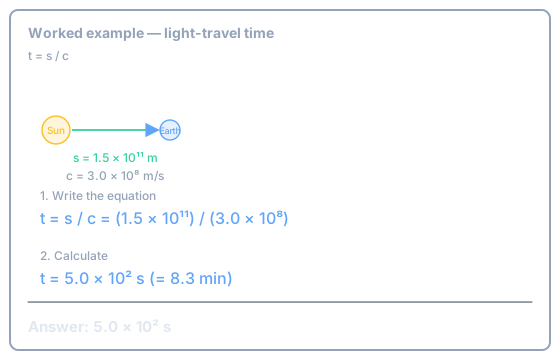
Time for light to travel a distance: t = s / c with c = 3.0 × 10⁸ m/s.
The Sun is 1.5 × 10¹¹ m from Earth. Calculate the time for light to travel from the Sun to Earth. c = 3.0 × 10⁸ m/s.
0/10