Ad Banner Placeholder
Cambridge IGCSE Physics · 0625
Chapter 6: Space physics — Part 4
Topic 6.2.2 · Stars
Galaxies and light-years
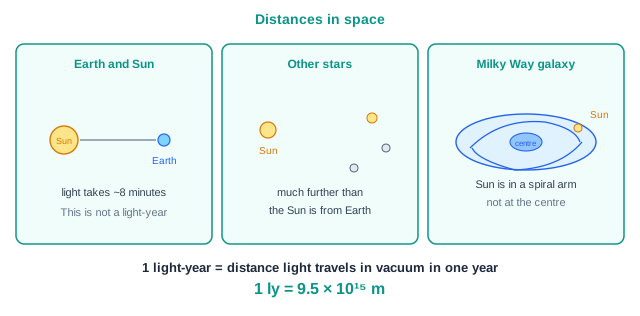
A galaxy is made of many billions of stars. The Sun is a star in the Milky Way. Other stars in the Milky Way are much further from Earth than the Sun is.
Astronomical distances can be measured in light-years. One light-year is the distance light travels in vacuum in one year.
1 light-year = 9.5 × 10¹⁵ m.
Life cycle of a star
Learn this sequence:
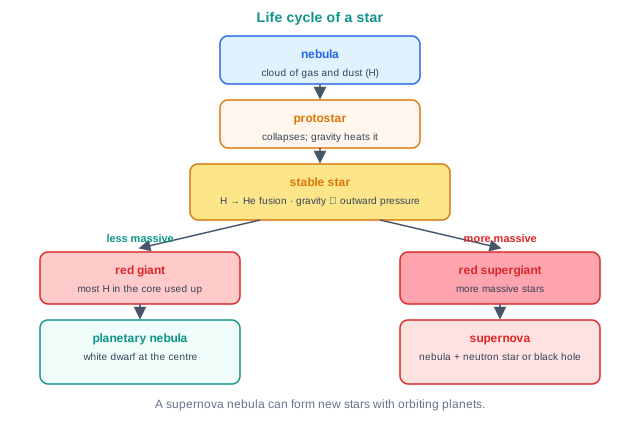
- A star forms from interstellar clouds of gas and dust that contain hydrogen.
- A protostar is a cloud collapsing and heating because of its own gravity.
- It becomes a stable star when inward gravity is balanced by outward pressure from the high temperature in the centre.
- All stars eventually run out of hydrogen as fuel.
- Most stars expand to red giants; more massive stars become red supergiants when most hydrogen in the centre has become helium.
- A red giant from a less massive star forms a planetary nebula with a white dwarf at the centre.
- A red supergiant explodes as a supernova, forming a nebula of hydrogen and new heavier elements, leaving a neutron star or a black hole.
- A supernova nebula may form new stars with orbiting planets.
0/10
Ad Banner Placeholder