Cambridge IGCSE Physics · 0625
Chapter 6: Space physics — Part 5
Topic 6.2.3 · The Universe
Galaxies, redshift and the Big Bang
The Milky Way is one of many billions of galaxies in the Universe. Its diameter is about 100 000 light-years.
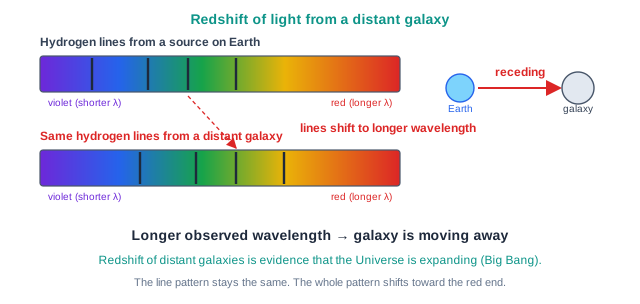
Redshift is an increase in the observed wavelength of EM radiation from receding stars and galaxies. Light from distant galaxies appears redshifted compared with light emitted on Earth.
Redshift of distant galaxies is evidence that the Universe is expanding and supports the Big Bang theory.
CMBR and the Hubble constant
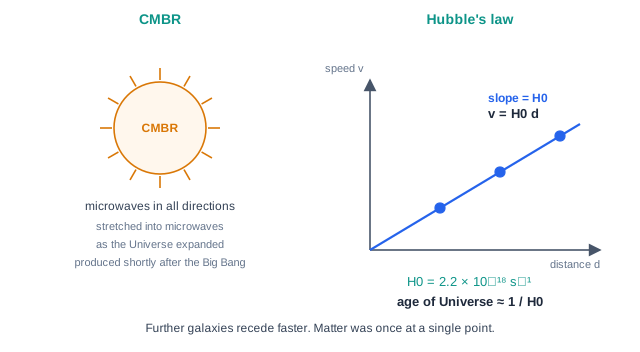
Cosmic microwave background radiation (CMBR) is microwave radiation of a specific frequency observed in all directions. It was produced shortly after the Universe formed and has been stretched into the microwave region as the Universe expanded.
The speed v at which a galaxy recedes can be found from the change in wavelength of its starlight (redshift). Distance d of a far galaxy can be found using the brightness of a supernova in that galaxy.
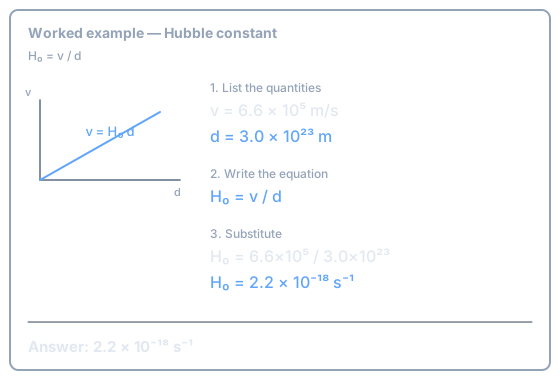
The Hubble constant H0 = v / d. The current estimate is 2.2 × 10⁻¹⁸ s−1.
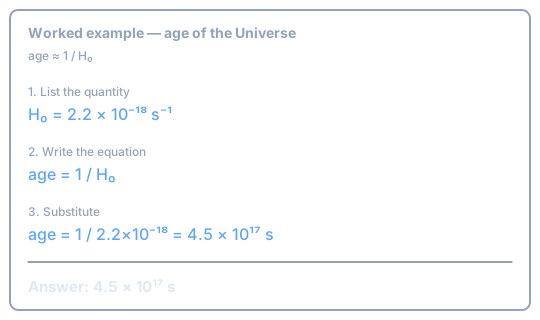
1 / H0 is an estimate of the age of the Universe. That supports the idea that all the matter in the Universe was once at a single point.
A galaxy recedes at 6.6 × 10⁵ m/s. Its distance is 3.0 × 10²³ m. Calculate the Hubble constant from these data.
Take H0 = 2.2 × 10⁻¹⁸ s−1. Estimate the age of the Universe.
0/10